
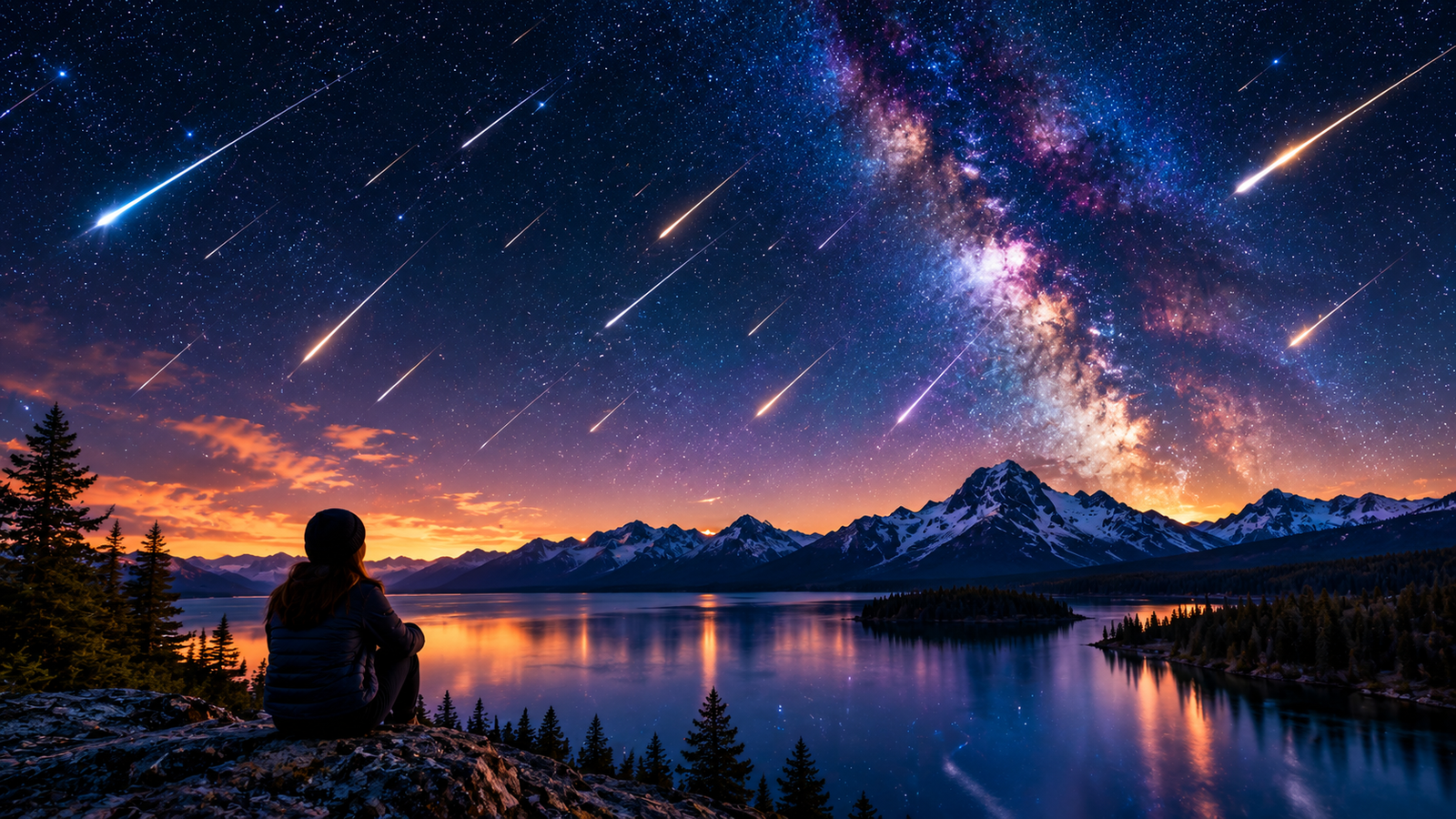
There is no telescope required to enjoy one of the most beautiful shows in the night sky.
Throughout 2026, Earth will pass through streams of dust and debris left behind by comets and asteroids. As tiny particles enter Earth’s atmosphere at high speed, they heat up and glow, creating the streaks of light commonly called shooting stars.
These events are known as meteor showers.
Some are easy to spot with the naked eye, while others require darker skies and a little more patience. The best-known showers include the Perseids, Geminids, Orionids, Leonids and Quadrantids.
And if you’re wondering when to look up next, the timing is especially interesting in late 2026.
The Draconids are active from October 6–10, with their peak around October 8–9, followed by the Orionids on October 21–22. Later in the year, the Leonids and Geminids bring two more major opportunities for stargazers.
So, when are the best meteor showers of 2026?
Where should you go to see them?
And what is the best way to watch shooting stars without a telescope?
Here’s your complete guide.
What Is a Meteor Shower?
A meteor shower happens when Earth passes through a stream of debris left behind by a comet or, in some cases, an asteroid.
Most of these particles are tiny — often no larger than grains of sand or small pieces of rock.
When one enters Earth’s atmosphere at high speed, friction and interactions with the atmosphere cause it to heat up and glow.
That bright streak is a meteor.
If several meteors appear to come from roughly the same region of the sky over a period of time, we call it a meteor shower.
NASA explains that meteor showers occur when Earth travels through debris trails left by comets and, in some cases, asteroids.
Why Do Meteor Showers Happen at the Same Time Every Year?
It may seem strange that the Perseids appear every August or the Geminids arrive every December.
The reason is Earth’s orbit.
Earth travels around the Sun on a predictable path. As our planet moves through space, it repeatedly crosses certain debris streams left behind by objects orbiting the Sun.
When Earth passes through one of these streams, the particles enter our atmosphere and create a meteor shower.
That’s why astronomers can predict the approximate dates of major meteor showers years in advance.
The exact viewing experience, however, can change every year because of weather, moonlight and the density of the debris encountered.
Meteor Shower Calendar 2026
Here are the major meteor showers to watch in 2026.
| Meteor shower | 2026 peak | Best viewing period | Viewing notes |
|---|---|---|---|
| Quadrantids | January 3–4 | After midnight to dawn | Short, sharp peak |
| Lyrids | April 21–22 | Pre-dawn | Best from Northern Hemisphere |
| Eta Aquariids | May 5–6 | Before dawn | Better from Southern Hemisphere |
| Southern Delta Aquariids | July 30–31 | Before dawn | Better farther south |
| Perseids | August 12–13 | Midnight to dawn | Excellent 2026 conditions |
| Draconids | October 8–9 | Evening | Northern Hemisphere favorite |
| Orionids | October 21–22 | After midnight | Fast meteors |
| Leonids | November 16–17 | After midnight | Can produce bright meteors |
| Geminids | December 13–14 | Late evening to dawn | One of the year’s major showers |
| Ursids | December 21–22 | Late night to dawn | Best from Northern Hemisphere |
NASA’s 2026 skywatching calendar lists the major meteor-shower dates, including the Perseids in August, Orionids in October, Leonids in November and Geminids in December.
1. Quadrantid Meteor Shower — January 3–4
The Quadrantids kick off the major meteor-shower calendar each year.
Their peak is short compared with many other showers, which makes timing particularly important.
The Quadrantids can produce bright meteors and are best viewed from the Northern Hemisphere.
Because the shower occurs during winter in the Northern Hemisphere, cold temperatures and cloudy weather can sometimes make viewing difficult.
For anyone willing to brave the cold, however, the Quadrantids can be an impressive start to the year.
2. Lyrid Meteor Shower — April 21–22
The Lyrids arrive in April and are one of the oldest known annual meteor showers.
They are usually a moderate shower, but occasional bright meteors and unexpected bursts make them worth watching.
The Lyrids are particularly well placed for observers in the Northern Hemisphere.
For the best chance of seeing them, find a dark location and watch during the hours before sunrise.
3. Eta Aquariid Meteor Shower — May 5–6
The Eta Aquariids are produced by debris from Halley’s Comet.
That’s one reason this shower is particularly interesting: the same comet is also responsible for the October Orionids.
The Eta Aquariids are generally better from the Southern Hemisphere because their radiant rises higher in the sky there.
In 2026, bright moonlight around the peak can make fainter meteors harder to see, so choosing a location where the Moon is less intrusive can help.
4. Southern Delta Aquariids — July 30–31
The Southern Delta Aquariids become active during the heart of summer.
They are generally easier to see from the Southern Hemisphere, although observers farther north can still catch some meteors.
The shower tends to produce relatively faint meteors, making dark skies especially important.
If you’re already planning a summer stargazing trip, this shower can be a great bonus.
5. Perseid Meteor Shower — August 12–13
The Perseids are one of the most famous meteor showers of the year.
They are associated with Comet Swift-Tuttle and are particularly popular because they peak during warm summer nights in the Northern Hemisphere.
But 2026 is especially interesting.
The Perseids peak around August 12–13 under a New Moon, meaning moonlight should provide very little interference.
NASA described the 2026 Perseids as offering excellent viewing opportunities, weather permitting.
The shower is active from approximately July 17 through August 24.
Best time to watch the Perseids
Although Perseid meteors can appear throughout the night, the best viewing is generally during the hours after midnight and before dawn.
Find a dark location, lie back and give your eyes time to adjust.
You don’t need to stare directly at the constellation Perseus. Meteors can appear across a large portion of the sky.
6. Draconid Meteor Shower — October 8–9
If you’re reading this article in early October 2026, the Draconids are one of the next meteor showers to watch.
The Draconids are active around October 6–10, with the 2026 peak around October 8–9.
Unlike many meteor showers, the Draconids can be worth watching during the evening rather than waiting until the early morning hours.
They are most favorable for observers in the Northern Hemisphere.
The Draconids are not normally the strongest shower of the year, but they have produced dramatic outbursts in some years.
That unpredictability is part of their appeal.
7. Orionid Meteor Shower — October 21–22
The Orionids are another major October meteor shower.
They are produced by debris from Halley’s Comet, making them a fascinating companion to the Eta Aquariids in May.
The Orionids are known for fast meteors and occasional glowing trains that can remain visible briefly after the meteor itself disappears.
In 2026, the Orionids peak on October 21–22.
However, bright moonlight can interfere with the view around the peak, meaning the best opportunity may come when the Moon has set and the sky becomes darker.
The shower is visible from both hemispheres.
Where should you look?
The meteors appear to originate from the direction of the constellation Orion, but you don’t need to stare directly at Orion.
In fact, looking somewhat away from the radiant can give you a better chance of seeing longer meteor trails.
8. Leonid Meteor Shower — November 16–17
The Leonids are associated with Comet Tempel-Tuttle.
They are famous because they have produced some extraordinary meteor storms in the past.
Most years are much quieter, however.
In 2026, the Leonids are expected around November 16–17.
As with most meteor showers, the number you actually see depends heavily on light pollution, weather, moonlight and your location.
The best approach is to get away from bright city lights and give yourself plenty of time.
9. Geminid Meteor Shower — December 13–14
If you only have time to plan one late-year meteor-watching trip, the Geminids deserve a place on your list.
They are one of the year’s major meteor showers and are known for producing bright, often colorful meteors.
Unlike many major showers, the Geminids are associated with an asteroid-like object called 3200 Phaethon, rather than a traditional comet.
NASA includes the Geminids among the major meteor showers of 2026, with the peak around December 13–14.
Best time to see the Geminids
The Geminids can become active from the evening onward, with viewing improving later at night.
If the weather is clear, stay outside for at least an hour.
You may see only a few meteors at first, followed by periods of much stronger activity.
10. Ursid Meteor Shower — December 21–22
The Ursids close out the main 2026 meteor-shower calendar.
They are best suited to Northern Hemisphere observers because their radiant is located near the north celestial pole.
The Ursids are not normally as active as the Perseids or Geminids, but they can still provide a pleasant end-of-year stargazing opportunity.
They peak around December 21–22.
What Is the Best Meteor Shower of 2026?
There isn’t one answer for everyone.
Your best shower depends on where you live, the weather and how much moonlight is present.
However, the Perseids and Geminids are among the biggest highlights of the 2026 meteor calendar.
The Perseids have an especially attractive setup because their August 12–13 peak occurs near a New Moon, giving observers very dark skies if the weather cooperates.
For readers in the Northern Hemisphere, the Perseids are particularly convenient because they occur during summer.
The Geminids offer another strong opportunity in December.
What Is the Best Time of Night to Watch a Meteor Shower?
For many meteor showers, after midnight and before dawn is the sweet spot.
Why?
Earth’s rotation means that during the second half of the night, your location is turning more directly into the stream of debris traveling through space.
That can increase the number of meteors visible.
However, not every shower follows exactly the same pattern.
The Draconids, for example, can be more interesting during the evening.
So don’t assume that every meteor shower requires you to stay awake until 4 a.m.
Where Is the Best Place to Watch Meteor Showers?
You don’t need to travel to an exotic destination.
The most important factor is darkness.
A rural location far from city lights can reveal dramatically more meteors than a brightly illuminated urban area.
Look for:
- Dark-sky parks
- Open countryside
- Beaches away from major towns
- Mountain locations
- Desert areas
- Large rural fields
- Remote campsites
The more artificial light you remove, the more faint meteors become visible.
How to Find a Good Stargazing Location
Before leaving home, check a light-pollution map and local weather forecast.
Ideally, choose somewhere with:
Clear skies: Clouds can completely ruin an otherwise perfect meteor shower.
Low light pollution: Darkness is one of the biggest factors in how many meteors you’ll see.
A wide view: Avoid tall buildings and trees blocking large sections of the sky.
Safe access: Never sacrifice personal safety just to reach a darker location.
Comfort: You may be outside for several hours, so bring appropriate clothing and something comfortable to sit or lie on.
Do You Need a Telescope to See Meteor Showers?
No.
In fact, a telescope can make meteor-shower viewing less convenient because its narrow field of view covers only a small portion of the sky.
Your eyes are often the best equipment.
A reclining chair or sleeping bag can be more useful than expensive astronomy equipment.
Binoculars can be fun for exploring stars and planets between meteors, but they aren’t necessary.
How to See More Meteors
Want to maximize your chances?
Follow these simple steps.
1. Get away from city lights
This is probably the single biggest improvement you can make.
2. Check the Moon
A bright Moon can wash out faint meteors.
A darker sky generally means more meteors become visible.
3. Watch for at least an hour
Meteor showers are unpredictable from minute to minute.
Don’t judge the entire night based on the first ten minutes.
4. Let your eyes adjust
Give yourself around 20–30 minutes away from bright lights.
Avoid repeatedly checking your phone.
5. Look at a wide area of sky
Don’t stare at one tiny point.
Meteors can appear almost anywhere.
6. Lie back
A reclining chair makes long viewing sessions much more comfortable.
7. Be patient
Sometimes you’ll see several meteors within minutes.
Other times, there may be a quiet stretch.
That’s normal.
Can You See Meteor Showers From a City?
Yes, but you’ll probably see fewer meteors.
Bright city lights make faint meteors difficult to detect.
The brightest meteors can still appear above urban areas, but if you want the full experience, travel somewhere darker.
Even moving 20–50 miles away from a major city can make a noticeable difference, depending on the landscape and surrounding light pollution.
Can You Photograph a Meteor Shower With a Phone?
Yes, although photographing meteors is much easier with a dedicated camera.
If you’re using a smartphone:
- Use Night Mode if available.
- Keep the phone completely still.
- Use a tripod.
- Use a long exposure when your phone allows it.
- Point the camera toward a large section of sky.
- Reduce screen brightness.
- Take many photographs.
The human eye may see a meteor that your phone misses, so don’t spend the entire night looking at your screen.
The goal is to experience the sky first and photograph it second.
What Is the Difference Between a Meteor, Meteoroid and Meteorite?
These three terms are easy to confuse.
Meteoroid
A meteoroid is a small piece of rock or metal traveling through space.
Meteor
When that object enters Earth’s atmosphere and produces a bright streak of light, it becomes a meteor.
Meteorite
If part of the object survives its journey through the atmosphere and reaches the ground, it is called a meteorite.
So the “shooting stars” you see during a meteor shower are actually meteors.
Meteor Shower vs. Shooting Star: Are They the Same Thing?
Not exactly.
A “shooting star” isn’t actually a star.
It’s a popular name for the streak of light produced when a small space particle enters Earth’s atmosphere.
During a meteor shower, many of these meteors appear to originate from the same region of the sky.
That’s why the event looks like a coordinated celestial display.
Why Do Meteor Showers Have Names?
Meteor showers are usually named after the constellation or star region where their radiant appears to be located.
For example:
- Perseids → Perseus
- Orionids → Orion
- Leonids → Leo
- Geminids → Gemini
- Lyrids → Lyra
The radiant is the apparent point in the sky from which the meteors seem to travel.
But remember: you don’t need to stare at the radiant itself.
Meteors can streak across almost any part of the sky.
Can Solar Activity Make Meteor Showers Better?
Solar activity and meteor showers are different phenomena.
A meteor shower happens when Earth passes through a debris stream.
A solar storm happens because of activity from the Sun.
However, both can create spectacular night-sky experiences.
During periods of strong solar activity, the Northern Lights can become visible in places where they normally aren’t.
That means an especially lucky stargazer could potentially see both auroras and meteors during the same night.
Internal link opportunity:
Link the phrase “Northern Lights forecast” to your existing article:
Why Is the Northern Lights Forecast Trending? How to See the Aurora Borealis and When to Go
You can also connect this article to your Solar Storm article when explaining the difference between solar activity and meteor showers.
Meteor Showers and the 2026 Night Sky
2026 is shaping up to be an exciting year for people who enjoy looking up.
There are major meteor showers throughout the year, along with eclipses, planetary events and other astronomical highlights.
NASA’s 2026 skywatching calendar includes the Perseids, Orionids, Leonids, Geminids and several other meteor showers.
For casual skywatchers, you don’t need to follow every astronomical event.
Pick a few nights, find a dark location and simply look up.
Sometimes the best astronomy experience is also the simplest.
Best Meteor Shower Nights to Mark on Your 2026 Calendar
If you want a simple shortlist, save these dates:
January 3–4: Quadrantids
April 21–22: Lyrids
May 5–6: Eta Aquariids
July 30–31: Southern Delta Aquariids
August 12–13: Perseids
October 8–9: Draconids
October 21–22: Orionids
November 16–17: Leonids
December 13–14: Geminids
December 21–22: Ursids
Peak dates can vary slightly by time zone and source, so check a current meteor-shower calendar before planning a dedicated trip.
Frequently Asked Questions
When is the next meteor shower in 2026?
As of early October 2026, the Draconids are active around October 6–10, with their peak around October 8–9. The Orionids follow with a peak around October 21–22.
What is the best meteor shower in 2026?
The Perseids and Geminids are two of the biggest annual highlights. The 2026 Perseids are particularly favorable because their peak occurs around the New Moon, creating darker skies when weather conditions cooperate.
What time is best to watch a meteor shower?
For many major showers, the best viewing is after midnight and before dawn. However, some showers, such as the Draconids, can be worth watching during the evening.
Do I need a telescope to see meteors?
No. Meteor showers are best viewed with the naked eye because you want to see as much of the sky as possible.
Where is the best place to see shooting stars?
A dark location away from city lights is ideal. Rural areas, dark-sky parks and remote locations generally provide better conditions.
Can I see meteor showers from the city?
Yes, but bright artificial lighting will hide many of the fainter meteors.
How long should I watch a meteor shower?
Try to stay outside for at least an hour. Staying for two or more hours gives you a better chance of experiencing periods of stronger activity.
Can the Northern Lights and meteors appear together?
Yes. They are caused by completely different processes, but both can be visible in the same night if aurora activity and a meteor shower occur simultaneously.
Final Thoughts
You don’t need expensive equipment, a professional observatory or years of astronomy experience to enjoy a meteor shower.
You need a reasonably clear sky, somewhere dark and enough patience to let the night unfold.
The 2026 meteor calendar offers plenty of opportunities, from the Quadrantids in January to the Perseids in August and the Geminids in December.
And for skywatchers reading this in October, the timing is especially good: the Draconids are active now, with the Orionids coming later in the month.
So choose a date, escape the city lights, put your phone away for a while and look up.
You might see the first meteor within seconds.
Or you might wait twenty minutes.
That’s part of the magic.
Because when that sudden streak of light finally crosses the sky, you know you’re watching something that began its journey through space long before you stepped outside.
2 thoughts on “Meteor Showers 2026: When to Watch, Where to Look and the Best Nights for Stargazing”