
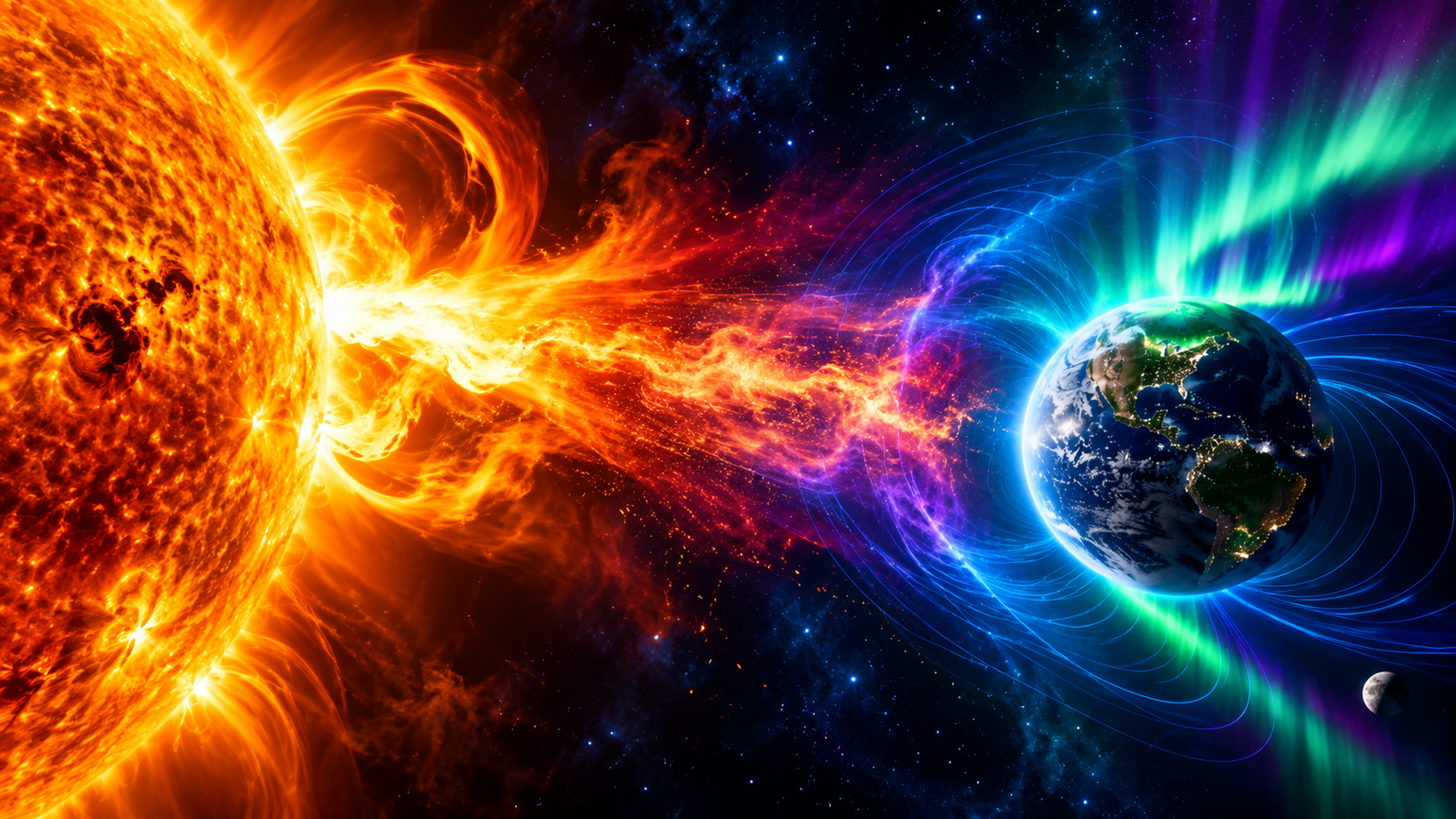
The Sun may look calm from Earth, but it is constantly changing.
Sometimes, enormous bursts of energy and solar material erupt from its surface and travel through space. When this activity reaches Earth, it can affect our planet’s magnetic environment, satellites, radio communications, navigation systems and even power infrastructure.
These events are commonly described as solar storms.
Solar storms have also become a popular topic because the same space weather that can create spectacular Northern Lights can also affect modern technology.
In 2026, solar activity continues to attract attention. NASA has reported several strong solar flares this year, including an X1.3 flare observed in July. NASA says solar flares and other solar eruptions can affect radio communications, electric power grids and navigation signals, while also creating risks for spacecraft and astronauts.
So, what exactly is a solar storm?
How does it reach Earth?
And should you be worried when scientists issue a solar storm warning?
Here’s what you need to know.
What Is a Solar Storm?
A solar storm is a period of disturbed space weather caused by powerful activity from the Sun.
The term can describe several different types of solar events, including solar flares, coronal mass ejections and strong streams of solar wind.
The Sun constantly releases particles and energy into space. Most of the time, Earth’s magnetic field and atmosphere protect us from the worst effects.
But a particularly strong eruption can send a huge amount of energy and charged particles toward Earth.
When those particles interact with Earth’s magnetic field, they can produce a geomagnetic storm.
That’s when solar activity becomes particularly interesting — and sometimes important — for people on Earth.
Why Is Solar Activity Trending?
Solar activity naturally rises and falls in cycles.
The Sun is currently in Solar Cycle 25, the cycle that began after the solar minimum around December 2019. NASA and NOAA originally expected the cycle to reach its maximum around 2025, but solar activity can remain significant around and after the maximum period.
Recent activity has kept solar weather in the news.
NASA’s Solar Dynamics Observatory has recorded multiple strong flares during 2026. For example, NASA reported an X4.2 flare in February, X2.4 and X2.5 flares in April, and an X1.3 flare in July.
These events don’t mean Earth is constantly in danger.
Instead, they demonstrate why scientists continuously monitor the Sun.
The more active the Sun becomes, the more opportunities there are for significant space-weather events.
What Causes a Solar Storm?
There isn’t just one type of solar event.
Three terms are especially important:
Solar Flares
A solar flare is a powerful burst of electromagnetic energy released by the Sun.
Flares are classified according to their strength, with X-class flares being the strongest category.
The number following the letter indicates the flare’s relative intensity.
For example, an X2 flare is stronger than an X1 flare.
Solar flares can affect radio communications on Earth, particularly when their radiation reaches the side of Earth facing the Sun.
NASA describes solar flares as powerful bursts of energy that can affect radio communications, power grids and navigation systems.
Coronal Mass Ejections
A coronal mass ejection, commonly called a CME, is different from a solar flare.
A CME can release an enormous cloud of magnetized plasma from the Sun’s corona.
If a CME is directed toward Earth, it can travel through space and interact with our planet’s magnetic field.
That interaction can trigger a geomagnetic storm.
Solar Wind
The Sun also continuously releases a stream of charged particles called the solar wind.
The solar wind is always reaching Earth, but changes in its speed, density and magnetic properties can influence space weather.
During periods of increased solar activity, conditions can become much more disturbed.
What Happens When a Solar Storm Reaches Earth?
Earth has a natural protective shield: its magnetic field.
When solar particles and magnetic fields interact with Earth’s magnetosphere, they can transfer energy into the near-Earth environment.
This can create several effects.
One of the most beautiful is the Aurora Borealis, or Northern Lights.
But auroras aren’t the only result.
Strong geomagnetic storms can also create problems for technological systems.
Potential effects include:
- Satellite disruptions
- Radio communication problems
- Navigation errors
- Increased satellite drag
- Electrical currents in power systems
- Problems for some high-frequency radio communications
- Increased radiation concerns for astronauts and spacecraft
NASA notes that solar activity can affect communications, navigation and power systems, while space-based technology can be particularly exposed to space weather.
Can a Solar Storm Affect the Internet?
This is one of the most common questions whenever a major solar storm is reported.
The answer is potentially, but not in the simple way social media posts sometimes suggest.
A solar storm does not automatically switch off the entire internet.
Instead, severe space weather can affect parts of the technological infrastructure that modern communication depends on.
Satellites, navigation systems, radio communications and electrical infrastructure can all be affected by sufficiently strong events.
That means an extreme space-weather event could create indirect problems for communication networks.
But an ordinary solar storm does not mean that everyone’s internet connection will suddenly disappear.
Can a Solar Storm Cause a Power Outage?
Yes, a strong geomagnetic storm can create electrical currents in long conductors on the ground.
That can potentially put additional stress on electrical grids.
This is one reason government agencies and power operators monitor space weather.
The risk depends on the strength of the storm, the characteristics of the Earth’s magnetic field, the local geology and the design of the electrical infrastructure.
So, while solar storms can pose a real technological risk, the effects vary significantly from one event to another.
Are Solar Storms Dangerous to People on Earth?
For most people on the ground, Earth’s atmosphere and magnetic field provide substantial protection from solar radiation and energetic particles.
That means you don’t need to panic every time a solar flare appears in the news.
The greater concerns are usually associated with technology and people operating outside Earth’s protective atmosphere.
Astronauts can face greater radiation exposure during significant solar events.
High-altitude aviation can also be affected by elevated radiation levels during particularly strong space-weather events.
NASA continues to monitor the Sun partly because space weather is important for future human exploration beyond Earth’s protective environment.
Can Solar Storms Cause the Northern Lights?
Absolutely.
This is one of the most fascinating connections between solar storms and everyday skywatching.
When charged particles from the Sun interact with Earth’s magnetic field and upper atmosphere, they can produce glowing curtains of light.
In the Northern Hemisphere, this is known as the Aurora Borealis.
During stronger geomagnetic storms, the auroral oval can expand toward lower latitudes.
That means people who normally have little chance of seeing the Northern Lights may occasionally get an opportunity.
This is why Northern Lights forecasts often start trending whenever a significant solar storm is expected.
Related article
For readers interested in seeing the aurora, link this section to your previous article:
Northern Lights Forecast: How to See the Aurora Borealis and When to Go
This creates a natural internal link between two closely related articles on your website.
What Is a Geomagnetic Storm?
A geomagnetic storm is a significant disturbance in Earth’s magnetic field caused by changes in the solar wind and solar magnetic field.
A CME can be an important trigger.
Scientists use scales to describe the strength of geomagnetic storms.
The NOAA scale ranges from G1, considered minor, through G5, considered extreme.
The stronger the geomagnetic storm, the greater the potential for technological effects and lower-latitude auroras.
However, the storm category doesn’t tell you exactly what will happen in your location.
Local conditions still matter.
What Does an X-Class Solar Flare Mean?
Solar flares are classified into several categories:
- A-class: Very small flares
- B-class: Small flares
- C-class: Moderate flares
- M-class: Stronger flares
- X-class: The most powerful category
Within each category, the number provides additional information about the flare’s strength.
For example:
X1 is less powerful than X5.
But there’s an important detail: a powerful solar flare doesn’t automatically mean a major geomagnetic storm will hit Earth.
Why?
Because a flare is an eruption of electromagnetic energy, while a geomagnetic storm generally depends on solar-wind conditions and often a CME reaching Earth.
The direction and characteristics of the eruption matter.
How Long Does a Solar Storm Last?
There isn’t one fixed duration.
The effects of a solar storm can last from hours to several days depending on the event and how Earth’s magnetic environment responds.
The initial solar eruption may happen long before the resulting geomagnetic effects are observed at Earth.
That’s why scientists use spacecraft positioned between the Sun and Earth to monitor incoming solar wind and improve short-term space-weather forecasts.
How Do Scientists Monitor Solar Storms?
Scientists use a large network of satellites, observatories and ground-based instruments.
NASA’s Solar Dynamics Observatory, for example, constantly observes the Sun and provides researchers with detailed information about solar activity.
NASA also operates missions that study the solar wind, magnetic fields and Earth’s space environment.
NOAA’s Space Weather Prediction Center provides operational forecasts, watches and warnings for space weather.
For readers who want to follow solar activity themselves, NOAA’s official space-weather resources are an excellent starting point.
How Can You Check the Solar Storm Forecast?
If you’re interested in space weather, you don’t have to rely on social media posts.
Look for information from official scientific organizations.
The two most useful sources are:
NOAA Space Weather Prediction Center — provides space-weather forecasts, watches and warnings.
NASA — provides scientific information about the Sun, solar flares, CMEs and space-weather research.
This is especially important when viral posts claim that a solar storm will cause dramatic consequences.
A headline saying “massive solar storm incoming” doesn’t necessarily mean a serious impact is expected where you live.
Always check the official forecast.
Is Solar Activity Increasing?
Solar activity isn’t simply increasing forever.
It follows an approximately 11-year solar cycle.
During the active part of the cycle, the Sun generally produces more sunspots and has more frequent periods of strong solar activity.
During quieter periods, solar activity declines.
Solar Cycle 25 began around the end of 2019, and scientists expected its maximum phase around 2025.
However, the solar cycle is not like a switch that turns off immediately after its maximum.
Activity rises and falls over time.
That’s why strong solar flares and other events can still occur after the estimated maximum period.
Could a Solar Storm Cause a Worldwide Blackout?
This question often appears whenever a major solar eruption makes the news.
The realistic answer is more complicated than a simple yes or no.
A sufficiently extreme geomagnetic storm could potentially create serious problems for electrical infrastructure, particularly if the event is strong enough and conditions are unfavorable.
But that doesn’t mean every solar storm causes widespread blackouts.
Modern infrastructure operators monitor space weather and have procedures designed to reduce potential impacts.
Scientists are also continuing to study how Earth’s systems respond to increasingly strong solar-wind conditions.
In 2026, NASA researchers published a study suggesting that some previously assumed limits on how Earth’s upper atmosphere responds to very strong solar wind may not be as firm as once thought. The researchers emphasized that more observations are needed to fully understand the relationship.
What Should You Do During a Solar Storm?
For most people, there is no special action required during an ordinary solar storm.
If you’re interested in the event, however, there are several useful things you can do.
Check official forecasts
Follow NOAA’s space-weather alerts rather than relying on viral social media predictions.
Watch for auroras
If you’re in a region where auroras are possible, a geomagnetic storm can be an exciting opportunity to see the night sky.
Keep important technology charged
During periods of significant space-weather activity, having essential devices charged is a sensible general preparedness habit.
Don’t stare at the Sun
A solar flare does not make it safe to look directly at the Sun.
Never observe the Sun without proper solar viewing equipment.
Solar Storm vs. Solar Flare: What’s the Difference?
These terms are often confused.
| Event | What it is |
|---|---|
| Solar flare | A powerful burst of electromagnetic energy |
| CME | A huge eruption of magnetized solar plasma |
| Solar wind | Continuous flow of charged particles from the Sun |
| Geomagnetic storm | Disturbance in Earth’s magnetic field caused by solar activity |
| Aurora | Visible light produced when energetic particles interact with Earth’s atmosphere |
Understanding these differences makes solar-weather news much easier to follow.
Why Solar Storms Matter More in the Modern World
Humans have always lived under the Sun’s changing activity.
What’s different today is how dependent civilization has become on technology.
Satellites help with communications, navigation, weather monitoring and many other services.
Aircraft and ships rely heavily on navigation systems.
Electrical grids connect huge regions.
Modern communications depend on a complex network of infrastructure.
That means understanding space weather isn’t simply an academic exercise.
It is part of preparing modern technology for the natural environment around Earth.
Solar Storms Are Both Beautiful and Powerful
There is something remarkable about solar storms.
The same activity that can create concerns for satellites and electrical systems can also produce one of nature’s most beautiful sights.
A powerful geomagnetic storm can turn the night sky into waves of green, purple and red light.
For scientists, however, these events are much more than a spectacular light show.
They are an opportunity to understand the Sun, Earth’s magnetic field and the space environment surrounding our planet.
And as technology becomes increasingly important to everyday life, understanding space weather becomes increasingly important too.
Frequently Asked Questions
What is a solar storm in simple words?
A solar storm is a period of unusually strong activity from the Sun that can disturb the space environment around Earth.
What causes a solar storm?
Solar storms can involve solar flares, coronal mass ejections and changes in the solar wind. When solar material and magnetic fields interact with Earth’s magnetic environment, they can produce geomagnetic storms.
Can a solar storm affect Earth?
Yes. Strong solar storms can affect satellites, radio communications, navigation systems and electrical infrastructure.
Can solar storms affect humans?
People on Earth’s surface are largely protected by the atmosphere and magnetic field. Astronauts and people at high altitudes can face greater radiation concerns during significant space-weather events.
Do solar storms cause the Northern Lights?
Yes. Geomagnetic storms can intensify auroras and sometimes make them visible farther from the polar regions.
Are solar storms dangerous?
Most solar storms do not pose a direct danger to people on the ground. The main concerns during stronger events involve technology, infrastructure and radiation exposure in space.
How often do solar storms happen?
Solar activity varies throughout the approximately 11-year solar cycle. Smaller events occur relatively frequently, while extremely powerful events are much less common.
What is the strongest solar storm ever recorded?
The Carrington Event of 1859 is widely regarded as one of the most powerful geomagnetic storms in recorded history. It produced dramatic auroras and disrupted telegraph systems.
Final Thoughts
A solar storm can sound frightening when you first hear the term, but understanding what is actually happening makes the phenomenon much easier to put into perspective.
The Sun is constantly producing energy and releasing particles into space. Occasionally, its activity becomes much more intense, producing flares, CMEs and disturbances that can reach Earth.
In 2026, NASA has continued documenting strong solar flares, making space weather an increasingly interesting topic for both scientists and the public.
For most people, the most visible consequence may be a spectacular Northern Lights display.
For technology operators and scientists, however, solar storms are a reminder that Earth exists inside a dynamic space environment.
The next time you see a headline about a solar storm, don’t just ask whether it is dangerous.
Ask a more interesting question:
What is the Sun doing right now — and how might Earth respond?
2 thoughts on “What Is a Solar Storm? Why Solar Activity Is Trending and What It Means for Earth”