
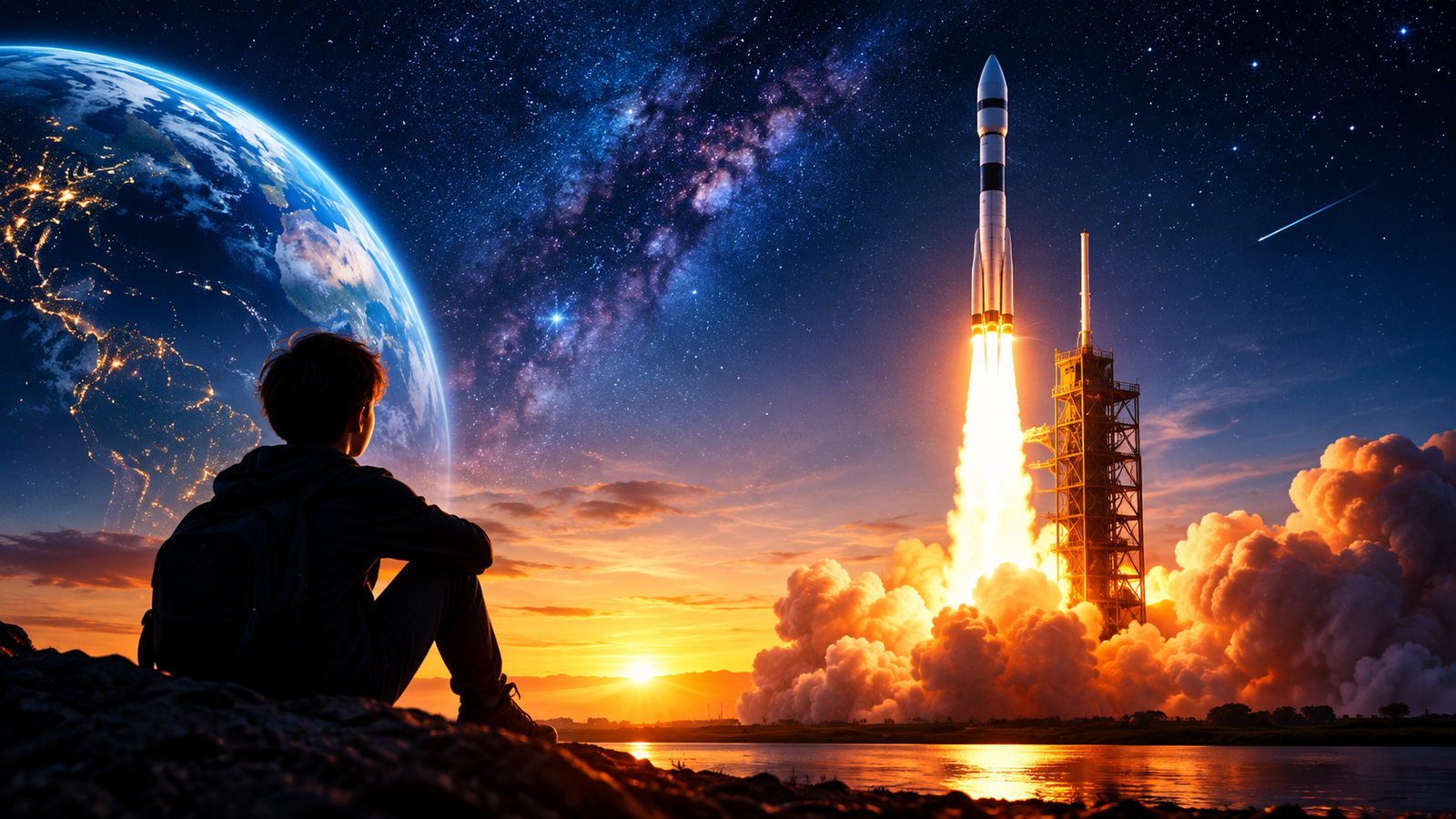
World Space Week 2026 is taking place from October 4 to October 10, bringing people around the world together to celebrate space exploration, science, technology and humanity’s growing access to space.
This year’s official theme is “Rocket Revolution,” a theme focused on how rapidly changing rocket technology, reusable launch systems, commercial space companies, startups and new space programs are transforming the way humans reach orbit.
With rocket launches, commercial spaceflight and lunar missions attracting worldwide attention, World Space Week 2026 is especially relevant for anyone interested in astronomy, technology, science and the future of space exploration.
But what exactly is World Space Week, when is it happening, what does “Rocket Revolution” mean, and why is it trending in 2026?
Here is everything you need to know.
World Space Week 2026 at a Glance
| Detail | Information |
|---|---|
| Event | World Space Week 2026 |
| Dates | October 4–10, 2026 |
| 2026 Theme | Rocket Revolution |
| Organized globally with | United Nations support |
| Focus | Space science, technology and exploration |
| Main topic in 2026 | The transformation of rocket and launch technology |
| Observed | Worldwide |
The United Nations officially recognizes World Space Week as an annual celebration held from October 4 through October 10.
What Is World Space Week?
World Space Week is an international celebration of space science and technology and their contribution to humanity.
The United Nations General Assembly proclaimed World Space Week through Resolution 54/68 on December 6, 1999. The annual celebration is designed to educate the public, inspire students, encourage interest in science and technology, demonstrate support for space programs and promote international cooperation in space activities.
Unlike a single conference or space mission, World Space Week involves events and activities organized by communities, schools, universities, museums, astronomy groups, space organizations and space enthusiasts around the world.
According to the World Space Week Association, the celebration brings together communities globally every October. Its website reports more than 50,000 events worldwide across more than 100 countries associated with the previous year’s celebration.
Related reading:
What Is Space Exploration? A Beginner’s Guide
How Do Rockets Work? A Simple Explanation
When Is World Space Week 2026?
World Space Week 2026 runs from Sunday, October 4, through Saturday, October 10, 2026.
The dates are not random.
October 4 commemorates the launch of Sputnik 1 on October 4, 1957. Sputnik 1 became the first human-made Earth satellite and marked a major milestone in the history of space exploration.
October 10 is also historically significant because the Outer Space Treaty entered into force on October 10, 1967. The treaty established important principles concerning the exploration and use of outer space.
Together, these dates provide the historical foundation for the annual celebration.
What Is the World Space Week 2026 Theme?
The official theme for World Space Week 2026 is:
“Rocket Revolution”
The theme highlights the rapid transformation of space-launch technology.
For decades, launching something into orbit was largely associated with national governments and a relatively small number of major space programs.
Today, the space-launch landscape is much broader.
Commercial companies, reusable rocket developers, startups, universities and emerging national space programs are becoming increasingly important participants in the space industry.
The United Nations says the 2026 theme focuses on how these developments are changing who can reach space, how frequently launches can occur and what space can be used for.
That makes “Rocket Revolution” much bigger than simply talking about rockets.
It is about a fundamental change in access to space.
Why Is “Rocket Revolution” Important?
One of the biggest changes in modern spaceflight is the development of reusable launch technology.
Traditional rockets were generally designed to be used once. After delivering their payload, major portions of the launch vehicle would be lost.
Reusable systems changed that model.
A rocket or booster that can be recovered and flown again has the potential to reduce some launch costs, increase launch frequency and make spaceflight more commercially attractive.
At the same time, new companies and organizations are developing different types of launch vehicles and spacecraft.
This creates a much more competitive and diverse space industry.
The rocket industry is becoming more commercial
Space is no longer exclusively a government activity.
Commercial space companies are developing launch vehicles, satellites, communications systems, lunar technologies and other space-related services.
This commercial expansion is one of the major reasons the phrase “Rocket Revolution” fits the 2026 World Space Week theme.
Reusable rockets are changing launch economics
Reusability is one of the most important concepts behind the modern launch industry.
Instead of treating every rocket as a completely disposable vehicle, companies are working toward systems that can recover and reuse expensive hardware.
The long-term goal is to make launching payloads into space more frequent and potentially more affordable.
More organizations are entering the space sector
Another major change is the growing number of organizations participating in space activities.
These include:
- Commercial aerospace companies
- Space startups
- Universities
- Research institutions
- National space agencies
- Private satellite companies
- Astronomy organizations
- Educational groups
The result is a broader space ecosystem than existed during the early Space Age.
Why Is World Space Week 2026 Trending?
There are several reasons World Space Week 2026 is attracting attention.
First, the event is currently taking place during October 4–10, meaning searches naturally increase around the dates of the celebration. The UN lists World Space Week among its October international observances.
Second, the 2026 theme connects directly to several major interests in technology and science: reusable rockets, commercial spaceflight, launch vehicles, lunar exploration and the growing private space industry.
Third, World Space Week is inherently global.
People in different countries can participate through educational programs, astronomy activities, exhibitions, lectures, science events and other space-related activities.
The World Space Week Association describes it as the largest annual space event in the world.
How Did World Space Week Begin?
The roots of World Space Week are closely connected with two major milestones in space history.
The first was Sputnik 1, launched on October 4, 1957.
Sputnik’s launch demonstrated that a human-made object could be placed into orbit around Earth and became one of the defining moments of the early Space Age.
The second milestone was the Outer Space Treaty, which entered into force on October 10, 1967.
The United Nations later established World Space Week to celebrate the contribution of space science and technology to humanity.
This is why the October 4–10 dates remain significant more than half a century after those events.
How Is World Space Week Celebrated?
World Space Week is not limited to professional scientists or astronauts.
Anyone can take part.
Activities can include:
- Stargazing events
- Astronomy nights
- School science projects
- Rocket demonstrations
- Space exhibitions
- Public lectures
- Planetarium programs
- Educational workshops
- Space documentaries
- Astronomy clubs
- STEM activities
- Community events
The International Planetarium Society notes that activities can range from STEM lessons and model rocket activities to stargazing events and community programs.
This makes World Space Week accessible to children, students, families and adults.
World Space Week 2026 and the Future of Space Exploration
The “Rocket Revolution” theme also raises a bigger question:
What will space exploration look like in the next decade?
The answer is difficult to predict, but several trends are already visible.
More frequent launches
As launch systems improve, the space industry is moving toward more frequent launches.
More frequent launches could support growing satellite networks, scientific missions, commercial services and exploration programs.
Greater commercial involvement
Private companies are becoming an increasingly important part of the global space ecosystem.
This could lead to new business models and technologies that were previously difficult or expensive to develop.
More lunar activity
The Moon is also becoming a major focus of modern space exploration.
Governments, commercial companies and international organizations are working on technologies and missions connected with lunar exploration.
As launch systems evolve, the cost and logistics of reaching the Moon could change as well.
More opportunities for students
The space industry also creates opportunities beyond astronauts.
Future space careers can involve:
- Aerospace engineering
- Software development
- Robotics
- Satellite technology
- Physics
- Data science
- Earth observation
- Space medicine
- Communications
- Materials science
World Space Week helps introduce younger generations to these possibilities.
Is World Space Week Only About Rockets?
No.
Although “Rocket Revolution” is the official theme for 2026, World Space Week covers the broader contribution of space science and technology.
That can include astronomy, satellites, Earth observation, communications, planetary science, space exploration, education and STEM.
The annual theme provides a common direction for activities, but organizations and communities can organize many different types of space-related events.
How Can You Celebrate World Space Week 2026?
You do not need specialized equipment to participate.
Here are a few simple ideas.
1. Look at the night sky
Find a location with relatively low light pollution and spend some time observing the night sky.
A basic stargazing app or astronomy guide can help identify planets and constellations.
2. Learn about rockets
Explore how rockets generate thrust, how orbital launches work and why reaching orbit requires enormous amounts of energy.
Read next:
How Do Rockets Work?
3. Follow a space mission
Space missions provide an easy way to understand how modern spacecraft, rockets and ground systems work together.
4. Visit a planetarium or science museum
Many organizations use World Space Week as an opportunity to organize special events and educational programs.
5. Try a simple STEM project
Students can learn about propulsion, orbital mechanics and engineering through safe educational experiments and model projects.
World Space Week 2026: Frequently Asked Questions
When is World Space Week 2026?
World Space Week 2026 is celebrated from October 4 to October 10, 2026.
What is the theme of World Space Week 2026?
The official 2026 theme is “Rocket Revolution.” It focuses on the transformation of rocket and space-launch technology and the growing accessibility of space.
Why is World Space Week celebrated?
World Space Week celebrates the contribution of space science and technology to humanity while encouraging education, public awareness, STEM interest and international cooperation.
Who started World Space Week?
The United Nations General Assembly proclaimed World Space Week in 1999 through Resolution 54/68.
Why does World Space Week start on October 4?
October 4 marks the anniversary of the launch of Sputnik 1, the first human-made Earth satellite, in 1957.
Why does World Space Week end on October 10?
October 10 marks the date the Outer Space Treaty entered into force in 1967.
Can anyone participate in World Space Week?
Yes. World Space Week activities can be organized by schools, museums, astronomy clubs, universities, communities and individuals. Space-related educational and public activities can be part of the celebration.
What does “Rocket Revolution” mean?
“Rocket Revolution” refers to the rapid evolution of space-launch systems, including reusable rockets, commercial launch providers, new launch vehicles, startups and other organizations expanding access to space.
Final Takeaway
World Space Week 2026 is more than a celebration of rockets. It represents how quickly access to space is changing.
From reusable launch systems and commercial space companies to universities, startups and new national space programs, more organizations are becoming part of the space industry.
The official theme, “Rocket Revolution,” captures that transformation.
As World Space Week continues through October 10, 2026, the biggest question is no longer simply how humans can reach space.
It is how much easier, more frequent and more diverse access to space could become in the years ahead.
For anyone interested in space, science or technology, World Space Week offers a timely opportunity to look beyond today’s launches and think about what the next generation of space exploration could look like.
Useful Resources
- United Nations — World Space Week: https://www.un.org/en/events/spaceweek/
- World Space Week Association: https://www.worldspaceweek.org/
- World Space Week 2026 information: https://www.un.org/en/property-cards-by-og-global-category/287/8227