
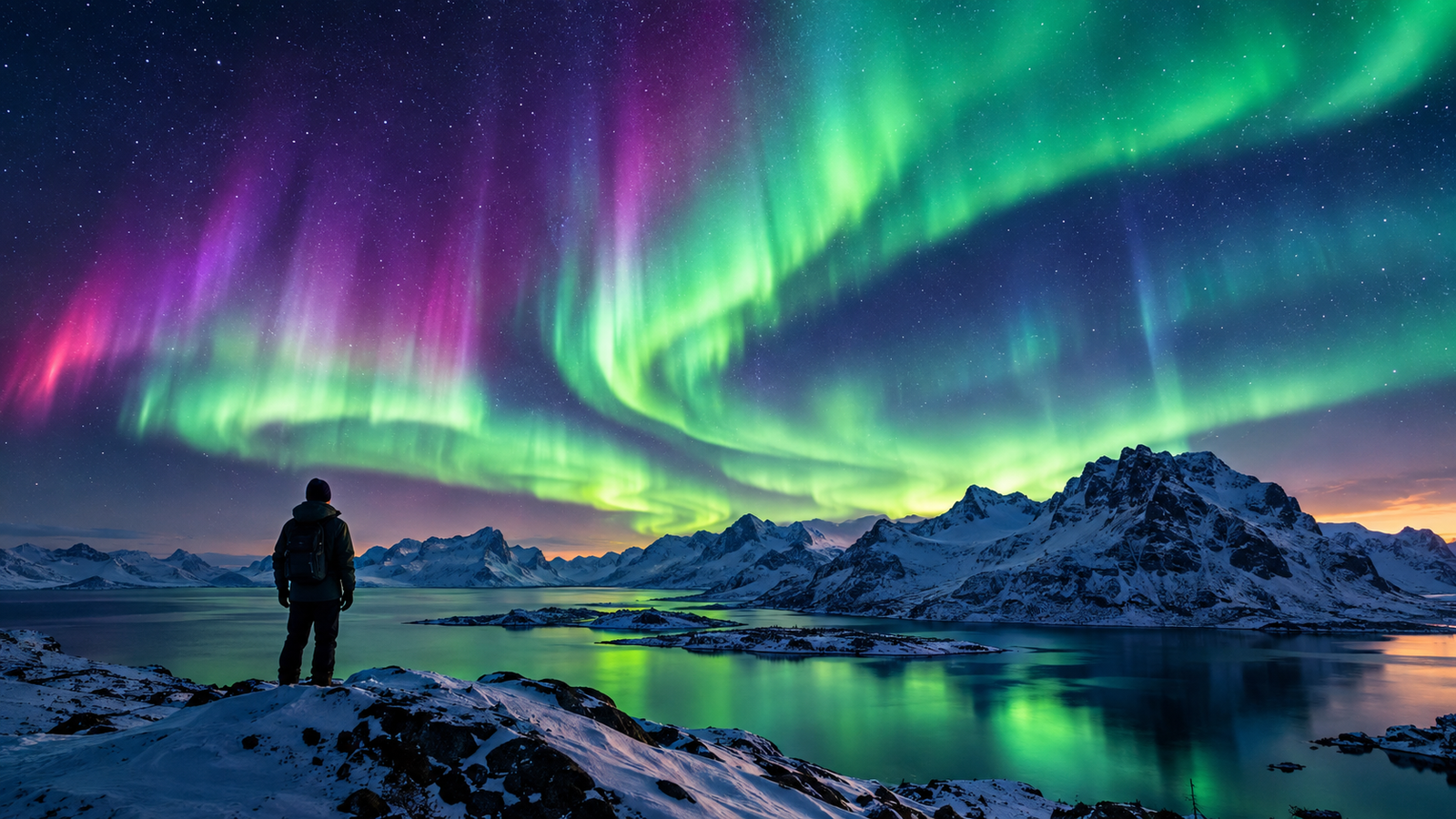
The Northern Lights forecast is trending again, and there is a good reason skywatchers are paying attention.
The Aurora Borealis has become a major attraction for travelers, photographers and anyone hoping to see one of nature’s most spectacular displays. Interest has increased again in October 2026 as solar activity creates opportunities for stronger auroras across parts of North America and other northern regions.
As of October 7, 2026, NOAA’s Space Weather Prediction Center has issued a G2 geomagnetic storm watch for October 9, following a solar eruption and an expected coronal mass ejection, or CME. If conditions develop as forecast, the Northern Lights could become visible farther south than during an ordinary aurora display.
But there is an important point to remember: an aurora forecast is not a guarantee that you will see the Northern Lights.
Clouds, darkness, light pollution, location and the exact strength of geomagnetic activity all matter.
So, when is the best time to see the Aurora Borealis, where should you go, and how can you check the forecast?
Here’s everything you need to know.
What Are the Northern Lights?
The Northern Lights, also called the Aurora Borealis, are a natural light display caused by activity from the Sun.
The Sun constantly releases charged particles into space through the solar wind. During stronger solar events, including coronal mass ejections, large amounts of solar material can travel toward Earth.
When these charged particles interact with Earth’s magnetic field and upper atmosphere, they can produce glowing curtains and waves of light.
The colors can include green, pink, purple and red, although green is one of the most commonly seen colors.
The aurora is concentrated around Earth’s magnetic poles, which is why places such as Alaska, northern Canada, Iceland, Norway and Finland are popular destinations for aurora hunters.
Why Is the Northern Lights Forecast Trending Right Now?
The latest interest comes from a combination of increased solar activity and a new geomagnetic storm watch.
According to recent reports, NOAA has issued a G2 geomagnetic storm watch for October 9, 2026, as a coronal mass ejection associated with a recent solar eruption approaches Earth. A storm of this strength can push the auroral oval farther toward lower latitudes, potentially giving more people a chance to see the Northern Lights.
Recent aurora activity has already generated attention across parts of the United States and Canada.
However, the exact visibility can change quickly.
The incoming solar material has to interact with Earth’s magnetic field in a favorable way. That means a forecast can look promising but still produce a weaker display than expected.
In other words, the forecast tells you when your chances may be better — it doesn’t promise an aurora show.
When Is the Best Time to See the Northern Lights?
There isn’t one single night every year when the Northern Lights appear.
Instead, your chances depend on three major things:
- Solar activity
- Darkness
- Clear skies
For general aurora watching, September through April is an excellent period because nights are long enough in northern regions.
NOAA says auroras are generally most visually appealing around 10 p.m. to 2 a.m. local time, although displays can occur outside those hours, particularly during stronger geomagnetic activity.
Best months for the Aurora Borealis
The traditional aurora-viewing seasons include:
September and October:
Excellent combination of darkness and relatively manageable weather in many northern destinations.
November to February:
Very long nights provide plenty of darkness, although winter weather can make travel more challenging.
March and April:
Another popular period because auroral activity can be favorable around the spring equinox.
NOAA notes that the spring and fall equinox periods can be particularly favorable for aurora activity because of the way solar wind interacts with Earth’s magnetic field.
What Time of Night Is Best?
If you’re already in a good viewing location, don’t simply look outside for five minutes and give up.
The aurora can appear, fade and return.
A useful general window is:
10 p.m. to 2 a.m. local time
But stronger geomagnetic storms can expand the active period into earlier evening or later morning hours.
If you’re traveling specifically to see the Northern Lights, staying for several nights is usually a better strategy than planning everything around one night.
Where Is the Best Place to See the Northern Lights?
The best locations are generally found beneath or near the auroral oval, a region surrounding the magnetic north pole where auroras occur frequently.
Some of the most popular destinations include:
1. Alaska
Alaska is one of the world’s most famous Northern Lights destinations.
Fairbanks is particularly popular because of its location beneath the auroral oval and its relatively dark surroundings.
The official Alaska tourism organization says the aurora season generally runs from late August through late April, with the Interior and Arctic regions offering particularly good opportunities.
2. Iceland
Iceland is another favorite because you can combine aurora hunting with dramatic landscapes, waterfalls, mountains and beaches.
The official tourism information for Iceland describes the aurora season as roughly September through April, with dark and clear skies being essential.
One advantage of Iceland is that you don’t necessarily need to travel deep into the Arctic wilderness. Getting away from major sources of light pollution can significantly improve your viewing conditions.
3. Northern Norway
Northern Norway is located directly within the auroral zone.
Places around Tromsø and northern Norway are especially popular with travelers looking for guided Northern Lights experiences.
Visit Norway notes that the auroral zone stretches across northern Scandinavia, Iceland, Alaska and Canada.
4. Finland
Finnish Lapland is another excellent destination.
According to Visit Finland, Northern Lights can be seen in Lapland from roughly late August to early April, with September–October and February–March among the stronger periods for aurora activity.
Glass-roofed cabins and remote lodges have also made Finland particularly popular with travelers who want to watch the aurora without spending the entire night outside.
5. Northern Canada
Northern Canada can offer outstanding aurora viewing because of its high latitude and relatively dark skies.
The farther north you travel and the farther you get from city lights, the better your chances generally become.
Can You See the Northern Lights From the United States?
Yes.
During ordinary aurora conditions, the best opportunities are usually concentrated in Alaska and the northernmost parts of the continental United States.
During stronger geomagnetic storms, however, the auroral oval can expand farther south.
That’s why major Northern Lights forecasts sometimes mention states such as New York, Idaho, Michigan or other northern states.
The current October 2026 forecast is attracting attention partly because a G2 storm can potentially make the aurora visible at lower latitudes than usual.
Still, visibility depends on the actual storm strength, local weather and the darkness of the sky.
What Does the Kp Index Mean?
If you’ve searched for a Northern Lights forecast, you’ve probably seen the term Kp index.
The Kp index is a measure of geomagnetic activity on a scale from 0 to 9.
Generally:
- Kp 0–2: Aurora tends to remain closer to the polar regions.
- Kp 3–5: Aurora becomes more active and can be brighter.
- Kp 6–7: Strong activity can push the aurora farther toward lower latitudes.
- Kp 8–9: Very strong geomagnetic storms can produce unusually widespread auroras.
NOAA emphasizes that these relationships are approximate. A high Kp number doesn’t automatically guarantee an incredible display at your exact location.
That’s why you should look at more than just the Kp number.
How to Check the Northern Lights Forecast
One of the best resources is NOAA’s Space Weather Prediction Center.
NOAA provides a dedicated 30-minute aurora forecast, which uses the OVATION model to estimate the location and intensity of auroral activity. The forecast provides roughly 30–90 minutes of lead time based on solar-wind observations.
You can also follow longer-range space-weather forecasts to identify potentially active periods.
A smart strategy is:
- Check the longer-range forecast a few days ahead.
- Check cloud cover for your location.
- Check the real-time aurora forecast shortly before going outside.
- Find a dark location away from city lights.
- Keep watching the sky rather than leaving after a few minutes.
External resource: Check the NOAA Aurora 30-Minute Forecast before heading outside.
What Weather Conditions Do You Need?
Solar activity isn’t enough.
You can have a powerful geomagnetic storm and still miss the Northern Lights because clouds completely cover the sky.
The ideal conditions are:
- Clear or mostly clear skies
- Very little light pollution
- A dark location
- A wide view of the sky
- Strong enough geomagnetic activity
- Enough patience to wait
This is one reason remote locations are so valuable for aurora watching.
How to See the Northern Lights With Your Eyes
Don’t expect the aurora to always look exactly like photographs online.
Long-exposure cameras can capture colors and details that are difficult to see with the naked eye.
To improve your experience:
Get away from artificial light.
Give your eyes time to adjust to darkness.
Look toward the northern sky.
Depending on the strength of the event, the aurora can spread across a much larger section of the sky.
Give yourself time.
Auroras can appear weak at first and become stronger later.
Avoid bright phone screens.
A bright screen can interfere with your night vision.
Dress for the weather.
Aurora hunting often involves standing outside for long periods, especially in Arctic destinations.
How to Photograph the Northern Lights
You don’t necessarily need an expensive professional camera.
Modern smartphones can sometimes capture auroras that look faint to the naked eye.
For a smartphone:
- Use Night Mode if available.
- Use a long exposure when possible.
- Keep the phone completely still.
- Use a tripod or stable surface.
- Focus on distant objects or infinity where your camera allows it.
- Take several photographs rather than relying on one shot.
For a dedicated camera, a wide-angle lens, high ISO and longer exposure can help capture more detail.
The most important thing is stability.
A shaky camera can turn a beautiful aurora into a blurry photograph.
Can You See the Northern Lights Without a Camera?
Yes.
And this is worth remembering.
A camera may show stronger colors than your eyes can see, particularly when the aurora is faint. But during a strong display, the human-eye experience can be spectacular.
The lights can appear to move, ripple and change shape across the sky.
That’s something a photograph can’t completely reproduce.
Why Are the Northern Lights Sometimes Green?
Green is the color most people associate with the Aurora Borealis.
It is produced when energetic particles interact with oxygen at particular altitudes in Earth’s atmosphere.
Other colors can appear too.
Depending on atmospheric conditions and the altitude of the auroral activity, displays can include shades of red, pink, purple and blue.
That is why two aurora events can look completely different.
Is 2026 a Good Year to See the Northern Lights?
Yes, 2026 is an interesting year for aurora watchers.
Solar activity is still an important factor in determining opportunities for strong auroras, and NASA continues to track the progression of the current solar cycle.
More importantly for travelers, individual geomagnetic storms can create excellent viewing opportunities even when a specific night wasn’t planned months in advance.
The October 2026 activity is a good example.
The key lesson is not to rely on a calendar alone.
Watch the space-weather forecast.
Northern Lights Viewing Checklist
Before leaving your hotel or home, check:
☐ Aurora forecast
☐ Cloud cover
☐ Local weather
☐ Moon brightness
☐ Light pollution
☐ Direction of the northern horizon
☐ Warm clothing
☐ Phone or camera battery
☐ Tripod or stable surface
☐ Enough time to wait
This simple checklist can make a huge difference.
Frequently Asked Questions
What are the Northern Lights?
The Northern Lights, or Aurora Borealis, are glowing displays in the upper atmosphere caused by interactions between energetic particles from the Sun and Earth’s magnetic field and atmosphere.
When is the best time to see the Northern Lights?
The Northern Lights are generally visible during the darker months, with September through April being a popular period. NOAA also notes that auroral activity can be particularly favorable around the spring and fall equinoxes.
What time is best for seeing the Aurora Borealis?
A common viewing window is approximately 10 p.m. to 2 a.m. local time, although strong geomagnetic activity can produce displays outside those hours.
Where is the best place to see the Northern Lights?
Popular destinations include Alaska, northern Canada, Iceland, northern Norway and Finnish Lapland.
Can the Northern Lights be seen in the United States?
Yes. Alaska is one of the best places, while stronger geomagnetic storms can make auroras visible across parts of the northern continental United States.
Can I photograph the Northern Lights with my phone?
Yes. Modern phones with Night Mode or long-exposure photography can capture auroras, particularly when the phone is kept completely still.
Is a high Kp number a guarantee of Northern Lights?
No. Kp is useful for understanding geomagnetic activity, but cloud cover, location, darkness and other space-weather conditions also matter.
Can the Northern Lights be predicted?
They can be forecast, but not perfectly. NOAA provides a short-term 30–90 minute aurora forecast, while longer-range forecasts provide broader guidance.
Final Thoughts
The Northern Lights are trending because space weather can suddenly turn an ordinary night into a spectacular natural event.
The current October 2026 forecast is particularly interesting because NOAA is watching conditions associated with a possible G2 geomagnetic storm on October 9, which could increase aurora visibility across parts of North America.
But you don’t need to wait for a major headline to start planning an aurora trip.
If you want the best chance of seeing the Aurora Borealis, focus on the basics: go far enough north, find dark skies, watch the space-weather forecast, check the clouds and be patient.
Sometimes the most memorable part is simply standing outside under a completely dark sky and waiting for the first faint green glow to appear.