
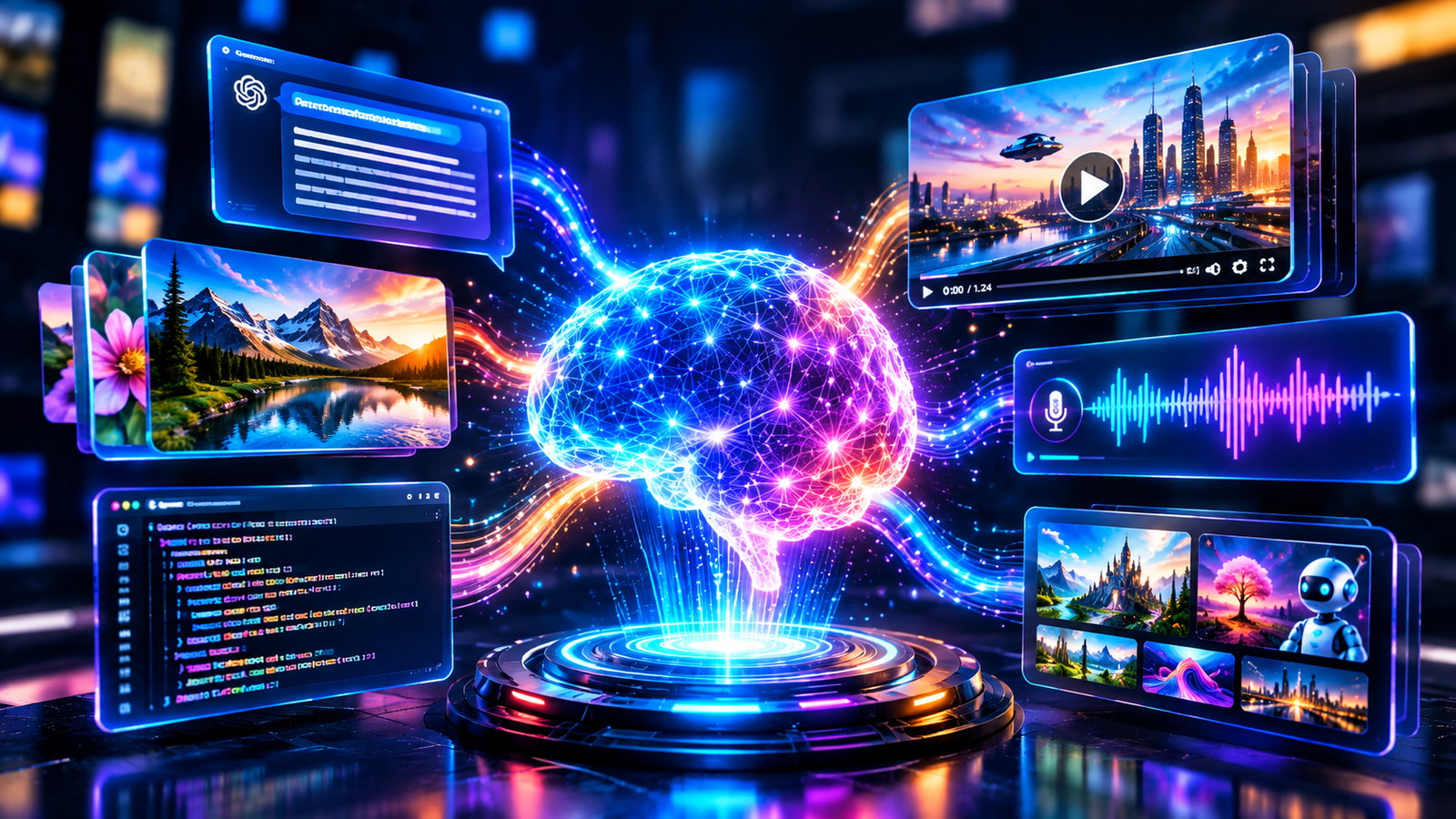
Artificial intelligence has been around for decades, but one branch of AI has changed the way ordinary people interact with technology: generative AI.
From writing emails and creating images to generating computer code, summarizing documents and producing audio or video, generative AI can create new content from a user’s instructions.
But what exactly is generative AI? How does it work? Is it the same as traditional artificial intelligence? And why has it become such an important technology?
In simple terms, generative AI is a type of artificial intelligence designed to generate new content based on patterns learned from data. That content can include text, images, audio, video, code and other digital material. NIST defines generative AI as a class of AI models that emulate characteristics of input data to generate derived synthetic content.
This guide explains generative AI from the ground up, without assuming you have a technical background.
What Is Generative AI?
Generative AI, or GenAI, is artificial intelligence that can create new content in response to an instruction or prompt.
Traditional software usually follows explicitly programmed rules. Generative AI works differently. Modern generative models learn patterns from large amounts of data and use those learned patterns to produce new outputs.
For example, you could ask a generative AI system:
“Write a short introduction about climate change.”
The system can generate an original response based on patterns it learned during training.
You could also ask it to:
- Create an image of a futuristic city
- Summarize a long document
- Write computer code
- Generate marketing ideas
- Translate text
- Create a presentation outline
- Produce or transform audio
- Help brainstorm a story
Generative AI isn’t limited to text. It can work across multiple types of content, including text, images, audio, video and code. NIST’s current terminology also recognizes these multiple modalities.
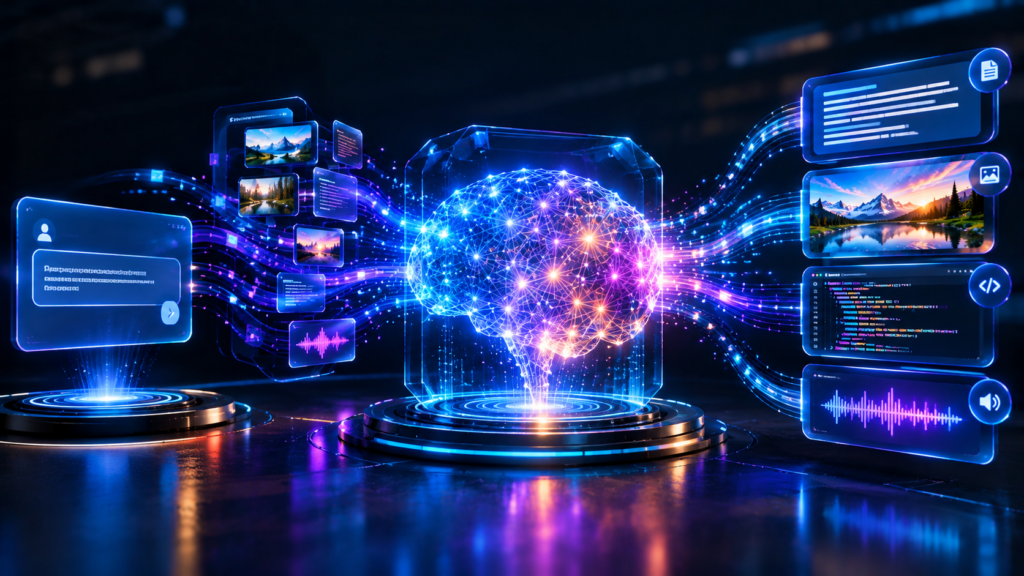
How Does Generative AI Work?
The technology behind generative AI can be complicated, but the basic idea is easier to understand.
1. AI models learn from data
A generative AI model is trained using large amounts of data.
Depending on the system, that data may include:
- Text
- Books
- Websites
- Images
- Audio
- Video
- Computer code
- Other digital information
During training, the model learns statistical and structural patterns within that data.
For a language model, this can include relationships between words, sentences and concepts.
For an image model, it can involve relationships between visual features and descriptions.
2. The model identifies patterns
Imagine reading millions of sentences.
Eventually, you begin to notice that certain words and ideas frequently appear together.
Generative AI models perform a much more sophisticated version of pattern learning using mathematical techniques and large-scale computing.
The model doesn’t simply store a database of ready-made answers.
Instead, it develops internal representations that allow it to generate outputs based on what it has learned.
3. You provide a prompt
The process begins when a user provides an instruction.
For example:
“Explain quantum computing to a 12-year-old.”
The AI interprets the prompt and generates an answer based on its learned patterns.
A different prompt can produce a completely different response.
4. The model generates an output
The AI then predicts and produces an appropriate sequence of content.
For text-generation systems, this involves predicting what tokens should come next based on the context.
For image-generation systems, the underlying process can be very different, depending on the model architecture.
The important point is that generative AI transforms learned patterns into new outputs.
Is Generative AI the Same as Artificial Intelligence?
Not exactly.
Artificial intelligence is the broader field. Generative AI is one category within AI.
A simple way to visualize the relationship is:
Artificial Intelligence → Machine Learning → Deep Learning → Generative AI
This isn’t a perfect classification for every modern AI system, but it is useful for understanding the relationship.
Artificial intelligence can be used for tasks such as:
- Prediction
- Classification
- Recommendation
- Planning
- Recognition
- Decision support
- Content generation
Generative AI focuses specifically on creating new content.
For example, a traditional AI system might determine whether an image contains a cat.
A generative AI system could create a new image of a cat wearing sunglasses.
Generative AI vs Traditional AI
| Feature | Traditional AI | Generative AI |
|---|---|---|
| Main purpose | Analyze, predict or classify | Generate new content |
| Typical output | Prediction or decision | Text, image, audio, video, code |
| Example | Spam detection | Email generation |
| Input | Data, signals or queries | Prompts, data or instructions |
| Creativity | Usually limited | Can generate novel outputs |
| Common applications | Recommendations, fraud detection | Chatbots, image generation, coding |
The distinction isn’t always absolute because modern AI systems can combine predictive and generative capabilities.
What Are the Main Types of Generative AI?
Generative AI isn’t one single technology.
It includes different models designed to work with different types of information.
1. Text Generation
Text-generation models can create and transform written language.
They can help with:
- Articles
- Emails
- Summaries
- Stories
- Research assistance
- Brainstorming
- Translation
- Question answering
- Code explanations
Large language models are one of the most visible examples of this category.
2. AI Image Generation
Image-generation systems can create images from text prompts or transform existing images.
For example:
Prompt:
“Create a cinematic photograph of a futuristic Indian city at sunset, with autonomous vehicles and skyscrapers.”
The AI can generate an image matching the requested description.
Image generation is being used in areas such as:
- Advertising
- Graphic design
- Concept art
- Marketing
- Education
- Entertainment
- Product visualization
3. AI Video Generation
Generative AI can also be used to create or modify video.
Potential applications include:
- Advertising
- Film production
- Education
- Social media
- Animation
- Product demonstrations
- Visual storytelling
Video generation remains a rapidly developing area, and capabilities vary significantly between models.
4. AI Audio and Music Generation
Generative AI can produce or transform audio.
Applications include:
- Music creation
- Voice generation
- Sound effects
- Podcast production
- Dubbing
- Audio editing
This makes it possible to create sophisticated audio content without traditional production workflows.
5. AI Code Generation
Generative AI can also generate computer programs.
Developers can use AI to:
- Write code
- Explain code
- Find bugs
- Generate tests
- Convert code between languages
- Create prototypes
- Document software
However, generated code should still be reviewed and tested by humans, particularly when it is used in production systems.
Real-World Examples of Generative AI
You may already be using generative AI without realizing how broad the technology has become.
Content creation
A writer can use AI to brainstorm headlines, outline an article or rewrite a paragraph.
Education
Students can ask AI to explain difficult concepts at different levels.
Software development
Developers can use AI assistants to generate code and explain programming problems.
Marketing
Businesses can generate advertising concepts, product descriptions and campaign ideas.
Design
Designers can use image-generation tools to explore visual concepts before creating a final design.
Customer service
Businesses can use generative AI to help customer-service agents draft responses and summarize conversations.
Research
AI can help users summarize large amounts of information and identify themes that deserve further investigation.
The key is to treat AI as an assistant rather than an unquestionable authority.
What Are the Benefits of Generative AI?
Generative AI has several potential advantages.
Faster content creation
AI can generate a first draft in seconds, giving people more time to edit and improve the final result.
Increased productivity
Routine tasks such as summarization, brainstorming and formatting can become faster.
Easier access to information
Conversational interfaces make it possible to ask questions in natural language rather than learning complicated software commands.
More creative experimentation
Creators can quickly explore different ideas, styles and concepts.
Personalized assistance
AI systems can adapt responses to different audiences, formats and levels of complexity.
Lower barriers to creation
Someone without professional design, programming or writing experience can use AI tools to experiment with things that previously required specialized skills.
What Are the Risks of Generative AI?
Generative AI is powerful, but it isn’t perfect.
One of the biggest mistakes people can make is assuming that an AI-generated answer is automatically true.
NIST has identified and studied a range of risks associated with generative AI, including issues involving inaccurate or misleading outputs, privacy, security and harmful content.
1. AI hallucinations
Generative AI can sometimes produce information that sounds convincing but is incorrect.
This is often called an AI hallucination.
For important decisions, information should be independently verified.
2. Misinformation
Because AI can generate realistic text, images, audio and video, it can also make misleading content easier to produce.
This creates challenges for:
- Journalism
- Education
- Social media
- Politics
- Businesses
- Online communities
NIST’s GenAI evaluation work specifically examines issues such as credibility, misleading content and the ability of generated content to fool detection systems.
3. Privacy concerns
Users should be careful about putting confidential information into AI systems.
Sensitive business documents, passwords, private financial information and other confidential material should not be shared with an AI service unless the user understands how that service handles the information.
4. Copyright and intellectual-property questions
Generative AI has raised complicated questions about training data, ownership and the use of generated material.
The legal situation can vary depending on the country, use case and specific circumstances.
5. Bias
AI models can reproduce or amplify patterns and biases present in their training data.
This is one reason human review remains important.
How to Use Generative AI Responsibly
You don’t need to avoid generative AI to use it responsibly.
A few simple habits can make a big difference.
Verify important information
Don’t automatically trust an AI answer simply because it sounds confident.
Protect private information
Think carefully before entering sensitive data.
Review generated content
AI output should usually be treated as a draft rather than a finished product.
Add human judgment
People remain responsible for deciding whether generated information is accurate, appropriate and useful.
Be transparent when appropriate
If AI substantially contributes to a piece of work, disclosure may be appropriate depending on the context and expectations of the audience. Google itself recommends considering transparency around AI-generated content when readers might reasonably wonder how it was created.
Why Is Generative AI Important?
The significance of generative AI goes beyond chatbots.
It changes the interface between humans and computers.
For decades, using computers often required users to understand software interfaces, menus, commands or programming languages.
Generative AI makes another interaction model possible:
Tell the computer what you want in natural language.
Instead of learning how to use every feature of a complicated application, users can increasingly describe the desired result.
That doesn’t mean traditional software is disappearing.
Instead, AI is becoming another layer through which people interact with digital tools.
What Is the Future of Generative AI?
Generative AI is likely to become more integrated into everyday software.
Instead of opening a separate AI chatbot, people may encounter AI capabilities directly inside:
- Search engines
- Smartphones
- Office software
- Browsers
- Creative applications
- Coding environments
- Customer-service systems
- Business platforms
The bigger shift may be from AI that simply answers questions to AI that can help complete tasks.
That could include systems capable of understanding a goal, planning several steps and interacting with software or other digital tools.
However, the future of generative AI will depend not only on how capable models become but also on how accurately, safely and responsibly they are deployed.
NIST’s work on generative AI emphasizes the need to evaluate capabilities and limitations while managing risks throughout the AI lifecycle.
Will Generative AI Replace Humans?
This is one of the most common questions about AI.
The short answer is: it depends on the task.
Generative AI can automate portions of many jobs, but that doesn’t necessarily mean it can replace every person performing those jobs.
In many situations, the more realistic model is:
Human + AI > Human alone
A writer might use AI for brainstorming but remain responsible for research, judgment and final editing.
A programmer might use AI to generate code but still need to understand, test and secure that code.
A designer might generate dozens of concepts with AI and then select and refine the strongest one.
The value may increasingly come from knowing when and how to use AI effectively.
Generative AI in Everyday Life
You don’t have to work in technology to benefit from generative AI.
For example, you might use it to:
At home:
Plan a weekly meal or explain a complicated topic.
At work:
Summarize a meeting or draft an email.
For learning:
Ask for a difficult concept to be explained in simpler language.
For creativity:
Brainstorm a story, image concept or video idea.
For technology:
Understand an error message or learn basic programming.
The important distinction is that AI can assist with these activities, but users should still apply judgment to the results.
Frequently Asked Questions About Generative AI
What does generative AI mean?
Generative AI refers to AI models designed to generate new content from learned patterns. The content can include text, images, audio, video, code and other digital material.
Is ChatGPT generative AI?
Yes. ChatGPT is an example of a generative AI application that can generate text and perform various language-related tasks.
What is the difference between AI and generative AI?
AI is the broader field of artificial intelligence. Generative AI is a category of AI focused on creating new content.
How does generative AI learn?
Generative AI models are trained on data and learn patterns and relationships within that data. Different models use different architectures and training methods.
Can generative AI create images?
Yes. Generative AI systems can create images from text descriptions and, depending on the system, edit or transform existing images.
Can generative AI write code?
Yes. Generative AI can generate, explain, modify and debug code. Developers should still review and test AI-generated code.
Is generative AI always accurate?
No. Generative AI can produce incorrect or misleading information. Important claims should be independently verified.
Will generative AI replace jobs?
Generative AI is likely to automate some tasks and change how many jobs are performed. The exact impact will vary by occupation, industry and how the technology develops.
Is generative AI safe?
Generative AI can be useful, but it has risks involving accuracy, privacy, security, bias and misinformation. Responsible use and appropriate safeguards are important. NIST maintains dedicated guidance for managing generative-AI risks.
What is the future of generative AI?
Generative AI is likely to become increasingly integrated into search, software, creative tools, smartphones and business applications. Future systems may move beyond generating content toward helping users complete multi-step tasks.