
Last updated: October 12, 2026
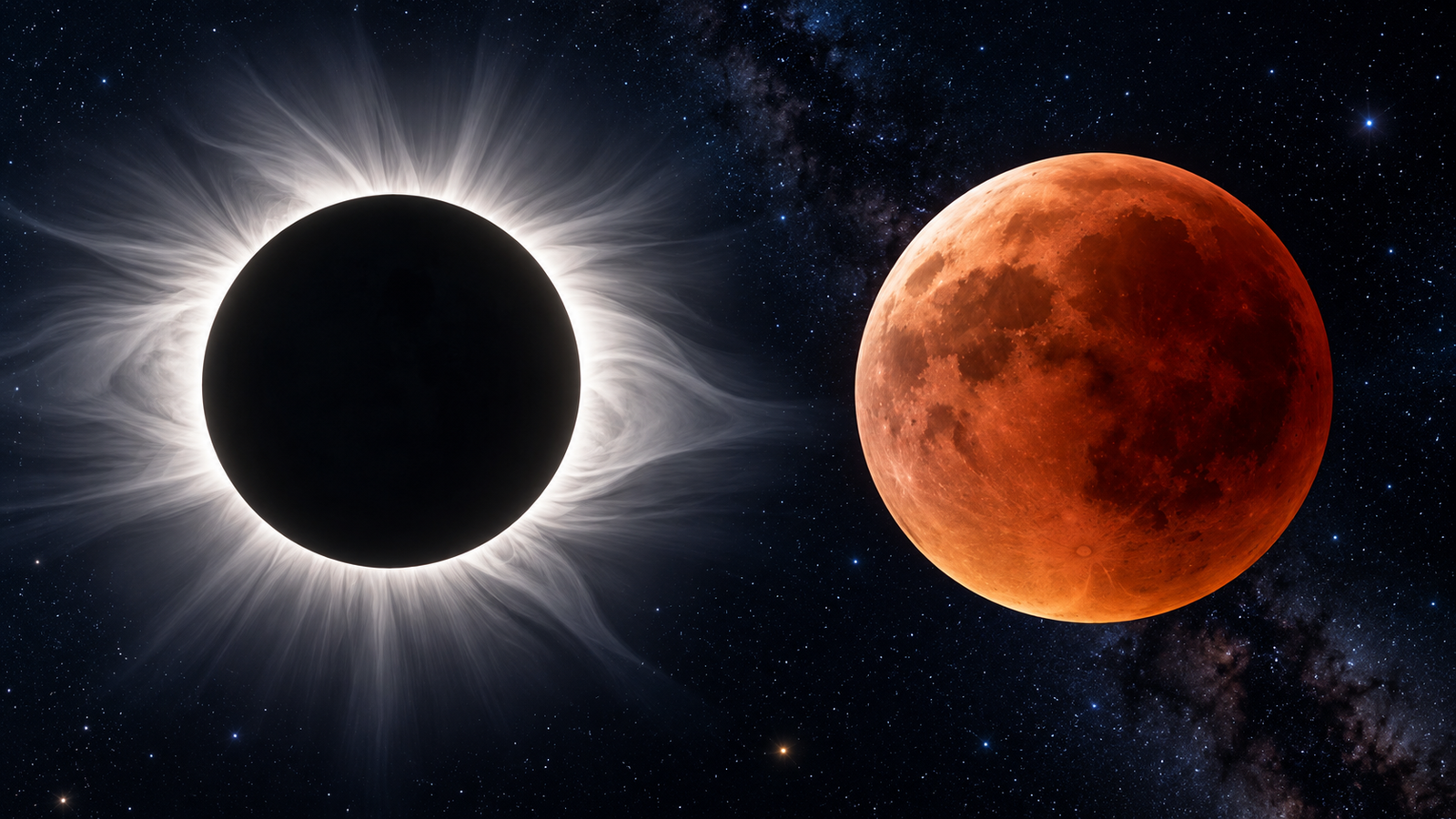
Imagine standing outside in the middle of the day when the sky suddenly begins to darken. Or watching a bright full moon slowly turn copper-red during an otherwise ordinary night.
Both experiences are caused by eclipses, but they happen for very different reasons.
A solar eclipse and a lunar eclipse involve the same three celestial bodies—the Sun, Earth, and Moon. The difference comes down to their positions, which object casts the shadow, and what observers can see from Earth.
Understanding these differences is useful for more than astronomy lessons. It helps you know when to look up, where an eclipse will be visible, and, most importantly, how to watch without risking your eyesight.
Here’s everything you need to know about solar eclipse vs. lunar eclipse, including nine important differences, the science behind each event, and practical viewing advice.
Solar Eclipse vs. Lunar Eclipse: The Quick Answer
A solar eclipse happens when the Moon moves between Earth and the Sun, blocking some or all of the Sun from view. A lunar eclipse happens when Earth moves between the Sun and the Moon, casting its shadow across the Moon.
The easiest way to remember the difference is:
- Solar eclipse: The Moon blocks our view of the Sun.
- Lunar eclipse: Earth’s shadow darkens the Moon.
- Solar eclipse safety: Specialized eye protection is required whenever any part of the Sun’s bright face is visible.
- Lunar eclipse safety: You can safely watch with your eyes, binoculars, or a telescope.
Solar eclipses occur at new moon, while lunar eclipses occur at full moon. Both require a particular alignment of the Sun, Earth, and Moon.
Solar Eclipse vs. Lunar Eclipse: Comparison Table
| Feature | Solar eclipse | Lunar eclipse |
|---|---|---|
| 1. Alignment | Sun → Moon → Earth | Sun → Earth → Moon |
| 2. Moon phase | New moon | Full moon |
| 3. What is obscured | The Sun, as seen from Earth | The Moon, by Earth’s shadow |
| 4. Time of day | Daytime | Nighttime for observers |
| 5. Visibility | Relatively narrow geographic region | Much of Earth’s nighttime hemisphere |
| 6. Eye safety | Special solar protection usually required | Safe to watch directly |
| 7. Types | Total, partial, annular, hybrid | Total, partial, penumbral |
| 8. Duration | Totality generally lasts minutes; entire event can last hours | Entire event can last hours; totality can last over an hour |
| 9. Appearance | Dark Sun, possible bright corona or ring | Darkened Moon, sometimes copper-red |
Although both events involve shadows, their different geometry creates very different experiences.
What Is a Solar Eclipse?
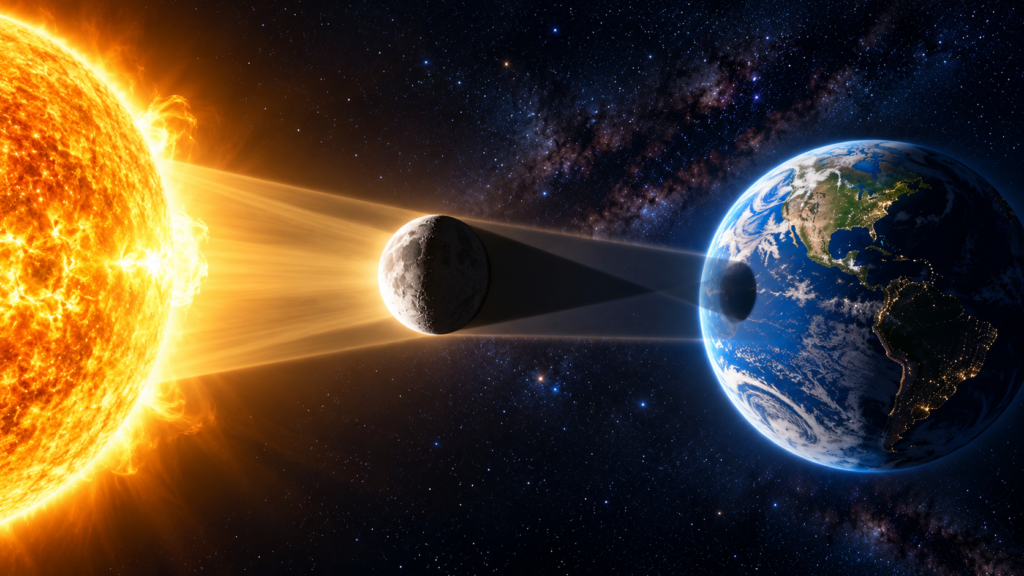
A solar eclipse occurs when the Moon passes between the Sun and Earth.
As the Moon moves across the sky, it blocks sunlight from reaching certain areas of Earth’s surface. People standing within the Moon’s shadow see the Sun become partly or completely obscured.
During a total solar eclipse, daylight can fade dramatically. The sky may resemble twilight, bright planets or stars may become visible, and the Sun’s outer atmosphere—called the corona—can appear around the Moon’s dark silhouette.
The experience depends on the observer’s location. Two people living only a short distance apart may see different eclipse phases.
What are the four types of solar eclipses?
1. Total solar eclipse
The Moon completely covers the Sun’s bright disk for observers within the path of totality. The Sun’s corona becomes visible during the brief total phase.
2. Partial solar eclipse
The Moon covers only part of the Sun. From Earth, the Sun can appear crescent-shaped.
3. Annular solar eclipse
The Moon passes in front of the Sun but appears too small to cover it completely. A bright ring remains visible around the Moon, creating the familiar “ring of fire.”
4. Hybrid solar eclipse
A rare eclipse that appears total from some locations and annular from others because of the geometry of the Moon’s shadow and Earth’s curved surface.
The difference between total and annular eclipses is partly related to the Moon’s changing distance from Earth.
When the Moon is farther away, it appears slightly smaller in the sky, making an annular eclipse possible.
Important: An annular eclipse is never safe to view directly without proper solar protection, even when most of the Sun is covered.
What Is a Lunar Eclipse?
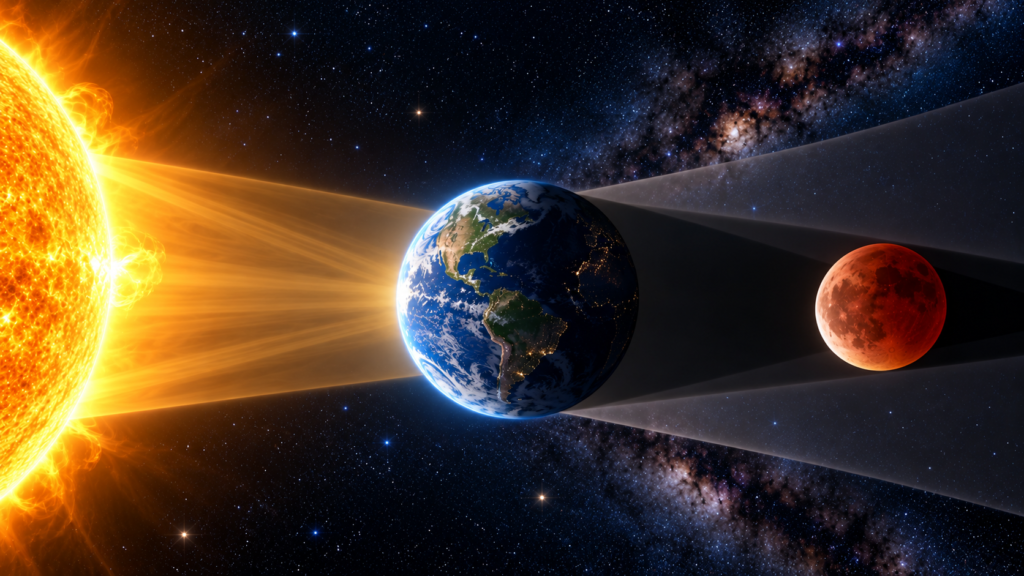
A lunar eclipse happens when Earth passes between the Sun and the Moon.
Normally, sunlight reaches the Moon and reflects toward Earth. During a lunar eclipse, Earth blocks some or all of that direct sunlight, causing its shadow to fall across the lunar surface.
Unlike a solar eclipse, which can be visible only from particular regions, a lunar eclipse can be observed across much of the nighttime side of Earth.
You don’t need expensive equipment or special protective glasses. A clear sky and an unobstructed view of the Moon are usually enough.
What are the three types of lunar eclipses?
1. Total lunar eclipse
The entire Moon passes into Earth’s dark inner shadow, known as the umbra. The Moon often takes on a reddish or copper-colored appearance.
2. Partial lunar eclipse
Only part of the Moon enters Earth’s umbra. A distinct dark region gradually spreads across part of its surface.
3. Penumbral lunar eclipse
The Moon passes through Earth’s lighter outer shadow, called the penumbra. The change in brightness can be subtle and difficult to notice without careful observation.
Why does the Moon turn red during a lunar eclipse?
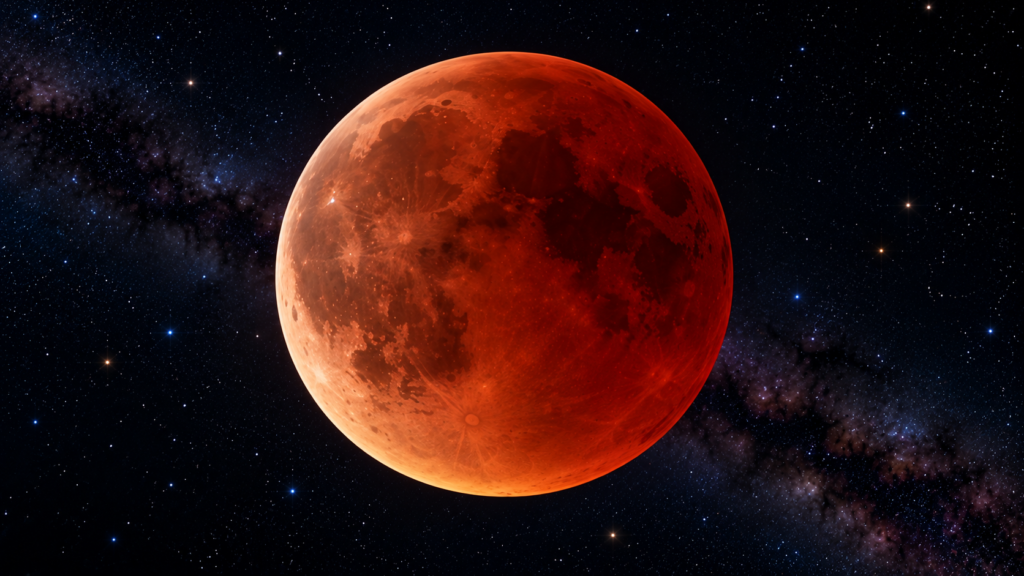
The reddish appearance of a totally eclipsed Moon is one of astronomy’s most memorable sights.
It happens because some sunlight passes through Earth’s atmosphere before reaching the Moon.
Earth’s atmosphere scatters shorter blue wavelengths more strongly, while some longer red and orange wavelengths are bent into Earth’s shadow.
This remaining light illuminates the lunar surface.
The result is a Moon that can appear orange, copper, brick-red, or deep brown.
Its exact appearance depends partly on atmospheric conditions, including clouds, dust, and volcanic particles.
This phenomenon is often called a Blood Moon, although that is a popular nickname rather than a separate scientific type of eclipse.
For more background on lunar events, see our related guide to Blood Moon eclipses.
Why Don’t Solar and Lunar Eclipses Happen Every Month?
This is one of the most interesting questions about eclipses.
The Moon orbits Earth approximately once every 27.3 days relative to the distant stars, while its cycle of phases takes about 29.5 days.
You might expect an eclipse at every new moon and full moon.
But that doesn’t happen.
The reason is that the Moon’s orbital plane is tilted by about five degrees relative to Earth’s orbital plane around the Sun.
Most months, the Moon passes slightly above or below the precise alignment needed to produce an eclipse.
Eclipses occur when the Moon is near one of the points where its orbit crosses Earth’s orbital plane, called orbital nodes, at the appropriate lunar phase.
These opportunities occur during periods known as eclipse seasons.
This geometry explains why eclipses are predictable yet relatively uncommon at any single location.
How Long Does a Solar Eclipse Last Compared With a Lunar Eclipse?
The answer depends on whether you’re measuring the entire event or only its most dramatic phase.
Solar eclipse duration
A solar eclipse can unfold over several hours as the Moon gradually moves across the Sun.
However, the total phase of a total solar eclipse lasts only minutes at a particular viewing location.
For example, during the April 8, 2024, total solar eclipse across North America, observers near the center of the path experienced up to approximately four and a half minutes of totality.
That short window makes accurate timing and location especially important.
Lunar eclipse duration
A lunar eclipse generally unfolds more slowly.
Earth’s shadow is much larger than the Moon’s, allowing the Moon to spend considerably longer moving through it.
The full event can last several hours, and the total phase of a total lunar eclipse can last more than an hour.
This makes lunar eclipses particularly suitable for casual skywatchers, families, and photographers.
Which Eclipse Is Safer to Watch?
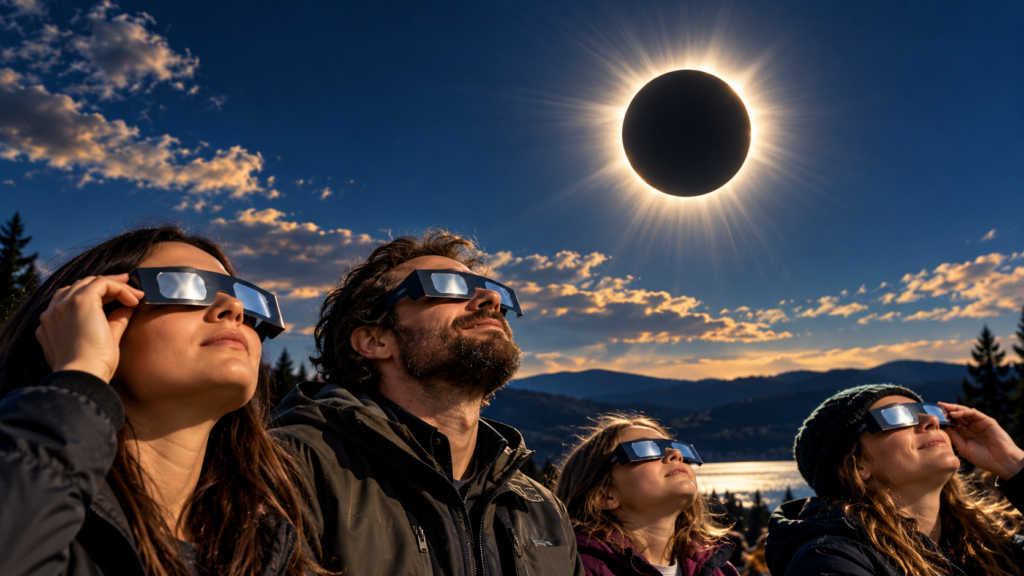
Lunar eclipses are safe to observe directly. Solar eclipses require special precautions because looking at the bright Sun can permanently damage your eyes.
The Moon does not become dangerous to look at during a lunar eclipse. You can observe it with your naked eyes, binoculars, or a telescope.
Solar eclipse viewing is different.
Even when most of the Sun appears covered, the remaining exposed sunlight can injure your retina.
How to watch a solar eclipse safely
Step 1: Get proper solar viewing glasses.
Choose glasses or a handheld solar viewer that complies with the ISO 12312-2 international safety standard.
Ordinary sunglasses, smoked glass, exposed film, and homemade dark filters are not safe alternatives.
Step 2: Inspect the glasses before using them.
Do not use viewers with scratches, tears, punctures, or other damage. Follow the manufacturer’s instructions.
Step 3: Wear the glasses before looking toward the Sun.
Keep your eyes protected throughout partial and annular phases.
Step 4: Understand the totality exception.
During a total solar eclipse, direct viewing without glasses is safe only for the brief period when the Moon completely covers the Sun’s bright face.
This exception applies only to observers actually inside the path of totality.
Put your glasses back on immediately when the first bright part of the Sun reappears.
Step 5: Be careful with cameras and telescopes.
Never look at the Sun through binoculars, a telescope, or a camera viewfinder without properly fitted solar filters designed for that equipment.
Eclipse glasses alone do not make unfiltered optical instruments safe.
If you’re unfamiliar with solar filters, seek guidance from an experienced astronomy organization before using optical equipment.
Can you watch a solar eclipse without eclipse glasses?
Yes, through indirect projection.
A pinhole projector allows you to see an image of the partially eclipsed Sun on another surface without looking directly at the Sun.
For a simple demonstration:
- Take two pieces of white cardboard.
- Make a small, clean hole in one piece.
- Stand with your back toward the Sun.
- Let sunlight pass through the hole onto the second piece.
- Watch the projected image change shape as the eclipse progresses.
Never look through the hole toward the Sun.
You can also observe crescent-shaped sunlight projected through the holes of a kitchen colander or gaps between tree leaves.
For official instructions, consult NASA’s eclipse viewing safety guide.
How to Watch a Lunar Eclipse: A Simple Guide
Lunar eclipses are among the most accessible astronomical events.
You can enjoy them without specialized equipment, although a little preparation improves the experience.
Step 1: Check visibility for your location
Not every lunar eclipse is visible from every country.
Confirm whether the Moon will be above your horizon during the event and check the local timing of its different phases.
Step 2: Find an open viewing location
Choose a place with a clear view of the sky, away from buildings and trees that might block the Moon.
Dark skies are helpful, but a lunar eclipse can often be seen even from a city.
Step 3: Allow enough time
A lunar eclipse develops gradually.
Try watching before the Moon enters Earth’s darker shadow so you can notice the changes in brightness and color.
Step 4: Use binoculars if available
Binoculars can make the changing shadow boundary and lunar surface features easier to appreciate.
They are optional, not essential.
Step 5: Photograph the event
A smartphone mounted on a tripod can capture useful images, especially when the Moon is bright.
For a dark red Moon during totality, a camera with manual exposure controls or a longer lens can help.
Our guide to photographing the Moon with a phone explains useful techniques for smartphone users.
When Is the Next Solar or Lunar Eclipse?
As of October 12, 2026, the next scheduled solar eclipse is an annular solar eclipse on February 6, 2027.
Its annular phase will be visible from parts of southern South America and the Atlantic region, while a partial eclipse will be visible from a wider area.
Another major event is the total solar eclipse on August 2, 2027, whose path crosses parts of southern Europe, North Africa, and the Middle East.
For readers in the United States, Canada, Australia, and the United Kingdom, visibility depends on the event and the observer’s exact location.
A globally occurring eclipse does not necessarily mean it will be visible from your home.
For updated event maps, timings, and geographic visibility, consult NASA’s eclipse information and its eclipse catalogs.
Check the date, local time zone, weather, and precise viewing path before planning a trip.
Solar Eclipse vs. Lunar Eclipse: Which Is Rarer?
The answer depends on what you mean by rare.
Solar eclipses occur regularly somewhere on Earth, but seeing a total solar eclipse from one particular location is uncommon.
The Moon’s darkest shadow covers a relatively narrow path on Earth’s surface.
Lunar eclipses, by comparison, are visible from a much larger region of the planet.
This means an individual observer generally has more opportunities to see lunar eclipses without traveling.
However, total lunar eclipses are not guaranteed every year, and the frequency of each eclipse type varies.
A useful distinction is that the global frequency of an eclipse and your personal chance of seeing it are not the same thing.
Common Eclipse Myths and Mistakes
Myth 1: A solar eclipse makes sunlight safe to look at
False.
Even a thin crescent of exposed sunlight can cause serious eye damage.
Use certified solar viewers whenever any part of the Sun’s bright face is visible.
Myth 2: A Blood Moon means something dangerous is happening
False.
The reddish Moon is a natural optical effect caused by sunlight passing through Earth’s atmosphere.
It does not indicate a change in the Moon’s physical composition or a threat to Earth.
Myth 3: Every full moon produces a lunar eclipse
False.
The Moon’s tilted orbit means that most full moons pass above or below Earth’s shadow.
Myth 4: You need a telescope to enjoy an eclipse
False.
Lunar eclipses are easily visible without equipment.
Solar eclipses can also be enjoyed through approved solar viewing glasses or indirect projection.
Myth 5: A solar eclipse and a solar storm are the same event
False.
A solar eclipse is caused by the Moon blocking our view of the Sun.
A solar storm involves activity originating from the Sun, such as solar flares or coronal mass ejections.
Although both relate to the Sun, they are different phenomena.
Readers interested in solar activity can explore our separate explanation of solar storms and their effects on Earth.
Frequently Asked Questions
What is the main difference between a solar eclipse and a lunar eclipse?
During a solar eclipse, the Moon passes between Earth and the Sun, blocking sunlight from reaching certain locations. During a lunar eclipse, Earth moves between the Sun and Moon, casting its shadow across the lunar surface.
Is a lunar eclipse safe to look at?
Yes. A lunar eclipse is safe to observe with the naked eye, binoculars, or a telescope. No special eye protection is required.
Can a solar eclipse happen at night?
A solar eclipse happens during the daytime for locations where it is visible. It cannot be seen from Earth’s nighttime side.
Why does a lunar eclipse only happen during a full moon?
A lunar eclipse requires Earth to be between the Sun and Moon. This alignment is possible at full moon, although most full moons do not produce an eclipse.
Why does a solar eclipse only happen during a new moon?
At new moon, the Moon is positioned generally between Earth and the Sun. An eclipse occurs only when the alignment is sufficiently precise.
Can a lunar eclipse damage your eyes?
No. Watching a lunar eclipse does not expose your eyes to the intense direct sunlight that makes solar viewing dangerous.
Which lasts longer, a solar eclipse or a lunar eclipse?
The dramatic total phase of a lunar eclipse generally lasts longer than solar totality. However, the complete progression of either type of eclipse can take several hours.
Can you photograph a solar eclipse with your phone?
Yes, but photographing the bright Sun requires suitable solar filtration and precautions appropriate to the camera setup. Never look at the Sun through unfiltered optical equipment or assume ordinary phone accessories provide adequate protection.
What is the difference between an annular eclipse and a total solar eclipse?
During a total solar eclipse, the Moon completely covers the Sun’s bright face. During an annular eclipse, the Moon appears slightly smaller, leaving a bright ring of sunlight visible.
Why can more people see a lunar eclipse than a solar eclipse?
Earth’s shadow covers a much larger area at the Moon than the Moon’s shadow covers on Earth’s surface. Consequently, a lunar eclipse can be visible across much of Earth’s nighttime hemisphere.
Final Thoughts
Solar and lunar eclipses are two remarkable demonstrations of how the Sun, Earth, and Moon move through space.
A solar eclipse occurs when the Moon blocks the Sun from our viewpoint. A lunar eclipse occurs when Earth’s shadow falls across the Moon.
Both events reveal the precision of celestial motion, but they offer different viewing experiences.
If you’re planning to watch an eclipse, remember the most important rule: protect your eyes when observing the Sun, and enjoy lunar eclipses without special eye protection.
With the right timing, a clear sky, and a little preparation, either event can become a memorable introduction to astronomy.
Further reading and scientific references